I have run for a lot of reasons in my life. I ran after the gypsy that robbed me in Spain. I ran a marathon. I ran through Los Angeles Airport dressed like a chicken. I ran to catch many a train. I ran to catch a ship bound for Tanzania. I ran when I felt sad, happy, anxious, excited, bored, tired and energetic. I ran to get in shape, to feel good, to get something off my mind. Really the reasons I run are fairly endless, however the most recent running experience I’ve had probably proves to be the most silly. I ran while on a very literal wild goose chase!
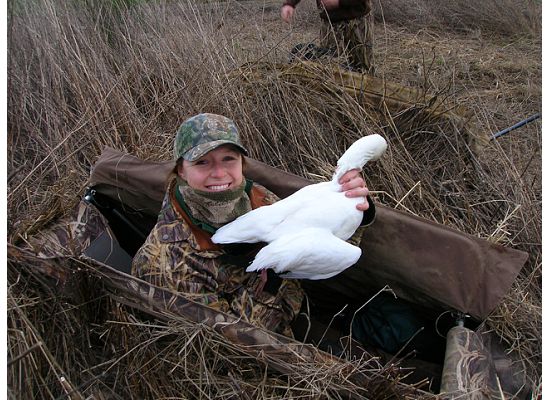
It was a nice day a few weeks ago and I was out driving around looking at a few fields. We have a particularly interesting situation here in Oregon, when the, as we like to refer to them Canadian Air Force (aka Canadian Geese) come into town they can wreak havoc on your crops. They eat like a buffet across all that you’ve worked so hard to get into the ground and get growing. This was a particularly large gaggle around 2,000, munching down and cackling away on the other side of a 50 acre field. After spotting them I reached back for my gun, as any self-respecting country girl would do, to find that I had forgotten it at home. I looked around some more hoping to find something to get these geese off my crop, unfortunately all I found was two arms I found and 6 legs (mine and my dog Yukon’s). I jumped out of my rig and set off across the field.
Now to give you a description of the best techniques for scaring geese with only your dog and yourself, I would say it looks quite ridiculous. It involves arms flying in the air like a crazy person, yelling at the top of your lungs anything you can think of, running as fast as you can over uneven grass stubble, and yes of course tripping along the way. To add to how funny this must look, my companion Yukon is not the best at this activity. He had a run in a few years back the first time we went to scare geese. He took off at Mach 5 right toward the geese. All it took was 6 of them to turn around, start squawking and flapping their wings for him to turn tail and run back into the bed of my pick-up, with this look like, “holy cow those things look mean!” So now he does more barking at me and as I imagine he’s saying, “You’re so CRAZY mom, those things are really dangerous…GET BACK IN THE PICK-UP!!” But I keep running…they must leave! As I get closer they are getting more and more nervous, I’m getting more and more winded, praying for them to just freaking leave already!!! And then the moment comes, a few pop their heads up and decide they have had enough. Off they go with the greatest of ease and in a very loud exit they are off to the next field. Although they don’t really make it to the next field, they just go to another corner of mine…Now I am truly on a wild goose chase. And we’re off again, Yukon barking, me yelling and yes doing quite a bit of laughing praying no neighbors drive by. I finally did get them to leave that day, only after they left me a wonderful surprise by crapping on my pick-up the green digested grass that I was hoping would stay in the ground. Life is so ironic at times!

Fighting with geese has become an interesting problem in the Willamette Valley. How do you find a good way to keep them off your ground and from eating your crop? We do a lot of hazing and I think that is fairly effective, but the problem becomes when you miss one day and they graze 20 acres of clover in that one time you were out of town, or had other things on your list and just didn’t get to it. To haze we use what we call goose crackers. They are like an M80 that is in a shotgun shell cartridge. When you shoot them they fly into the air before exploding, so that you can get particularly close to the geese with the loud noise. We are licensed in the state the carry these shells and use them, so when we went to buy more this past year we were frustrated to find out that now not only do you need to be licensed in the state, you also need a federal permit. Just another hoop to jump through that is added on to the most effective tool that we have out there. I know many farmers who just gave up because the process to get federally licensed was so tedious. I did go through the process and am waiting to hear if I get approved or not. It took quite a bit of work, including getting finger printed and filling out pages and pages of application. I think the worst part was realizing that while we’re struggling on our farms to protect our crops, government is making it more difficult to legally help with the problem. They don’t want their protected birds to be killed, and I don’t want them on my crops, so let me do what is right and haze without all the hoops and frustration! Hopefully we’ll be able to have that tool back as a way to help take care of our crops, if not , it looks like I’ll be spending more time goose hunting than farming in the years to come.


 NuttyGrass