I recently got back from a 2 week mission trip to Kipkaren Kenya. As I have said before traveling is a true passion of mine. It stared young when my parents took us to Australia to get my first taste of life outside the States. Since then I have been quite a few places, the only continent I haven’t hit is Antarctica and believe me I’m looking in to how to get there one day. I was lucky enough to spend a few days in Tanzania, a few more in South Africa and about a week in Egypt, all during college study abroad programs. So I have experienced a few very different areas in Africa, but only as a tourist. I remember thinking how I felt almost cheated by not getting to see the real people beyond my safari tour guides, who lived and worked on this huge continent. Well this January I was able to travel 20 hrs. flying time to Kenya. Only this time I wasn’t going to be escorted around and hanging out with all the other European and American tourists, I was going with a group of 6 other individuals to teach Kenyans in Kipkaren a little about farming (farming passion), and a little about medical care (EMT passion). We had a diverse group going, some of us with agricultural backgrounds, some medical, some with a passion for helping anywhere they could, some who have fed the hungry here in the US and others who were just looking for a way to serve God overseas. The trip was incredible to say the least and although I wish I could bore you with a 10 page blog about all of it, I’m going to focus just two blogs on this whole trip. This one will be about the CPR and First Aid training class, and the next will focus on our farming classes. We did write a blog while we were there and you can find that at, www.salemsekenya.blogspot.com.
The roads in Kenya leave much to be desired. I am not kidding when I say that I wouldn’t drive my 4wheeler down some of these roads let alone a vehicle, or more importantly an ambulance. Not only are the roads treacherous, they are also very dangerous. Cars swerving in and out of traffic, passing, honking, squeezing in where ever they could fit while a semi-truck going the other direction comes at them with great speed and bad brakes. At one point on our way to Nairobi we were put on a gravel detour road, it was really dusty and had a lot of corners you couldn’t see around; of course though our Kenyan driver wasn’t to be deterred by this, he was still passing like crazy at every slow vehicle that got in our way. So someone had the nerve to ask if this was a 2way detour, “No” he replied with ease, “1 way I’m sure!” 2 minutes later after passing a semi on a particularly blind corner, a fuel truck came barreling by going the other direction. We all looked at each other wide eyed, “Well I guess it’s a 2 way detour.” Our driver replies nonchalantly. We were all peeing our pants! This, my friends, is Africa.
I start off with that introduction to let you know that the infrastructure throughout Kenya is very poor. So getting supplies, people, or anything anywhere seems to be much more challenging than anything we are used to here in the states. For instance if you were to get injured in rural Kenya you can do 1 of 2 things:
1. Call 222, equivalent of 911.
2. Make an audible noise followed by a brief description of the incident and it will be passed along from village to village. Ex: WOO WOO, dog bite, WOO WOO dog bite.
If you were to choose the first option be ready to wait not minutes, hours if you’re lucky, but most likely a few days for an ambulance to get to you. I’m not sure if this entails planning ahead to do dangerous activities and calling days before you even begin or not, but I don’t think that it’s an option that is used very often. If you decide on the second option, surprisingly enough within a few hours you’re likely to get some kind of help your way. It won’t be an ambulance, more likely a matatu (bus taxi) or a piki piki (motorcycle taxi) that is coming to take you to the nearest hospital probably hours away. Neither choice would be my first, but this is what they are faced with, and in the end makes for many deaths that could have been stopped, many with simple first aid to keep them alive until they can get to a hospital.
One of the first things that really struck me was the mentality that because they weren’t doctors, they couldn’t help anyone. They have this feeling like they are not worthy to do anything, they just have to pick up and get someone to a doctor as fast as they can, or in the worst case do nothing. And as you can already see, fast isn’t fast in Africa when it comes to medical care. So our first objective was letting them know that they can help! That small things such as stopping bleeding from wounds, or opening someone’s airway, and general assessment of what is going on with someone who may be having an emergency, and what to do next. We taught the Heimlich maneuver, CPR, and many of the concepts that anyone here would learn when taking a first aid course.
We also covered some things that wouldn’t be covered in a First Aid course here in the U.S. I was lucky to have another teacher there with me who used to work with the Red Cross and has gone and taught this class 3 times in Kipkaren. Since she has been over there a few times and in this particular area she was more prepared to cover other topics that she knew challenged the people in Kenya and may not be covered in traditional

classes. For example Kenya has the 2 most deadly snakes in the world, and they are all over the place. They also have many deadly spiders. It’s to the point that they don’t even distinguish good and bad snakes or spiders, they just consider them all bad and kill every single one they see. There is no running away from them screaming, unless you’re running to grab a stone to kill it with! This is not something that I got to experience (THANK GOODNESS!!! I’m a wuss when it comes to both snakes and spiders!) We also talked about how to boil water to make it safe for drinking. Simple concepts such as not using the same pot that you used to get the water from the river as the pot to store your clean water, unless you also sterilize the pot. Things that we take for granted, such as clean water, there can mean healthy or sick, life or death.

I don’t want to make them out to be “dumb” about things, they just truly have never been taught such simple skills. Things that we might see in a movie even, such as stopping the bleeding of a wound with pressure and bandages. I have to admit though that one of my favorite parts of the class was teaching them how to brace, bandage, and transport patients. We made cots out of large sticks and blue jeans, braces using scarves, and tourniquets with pens and string. They were very creative!
To finish up I would like to share two stories with you. One is about one of the girls named Concepta who was a student at the training center. She took our first aid CPR class and was one of my favorite students. A week or so after we left Concepta collapsed while at
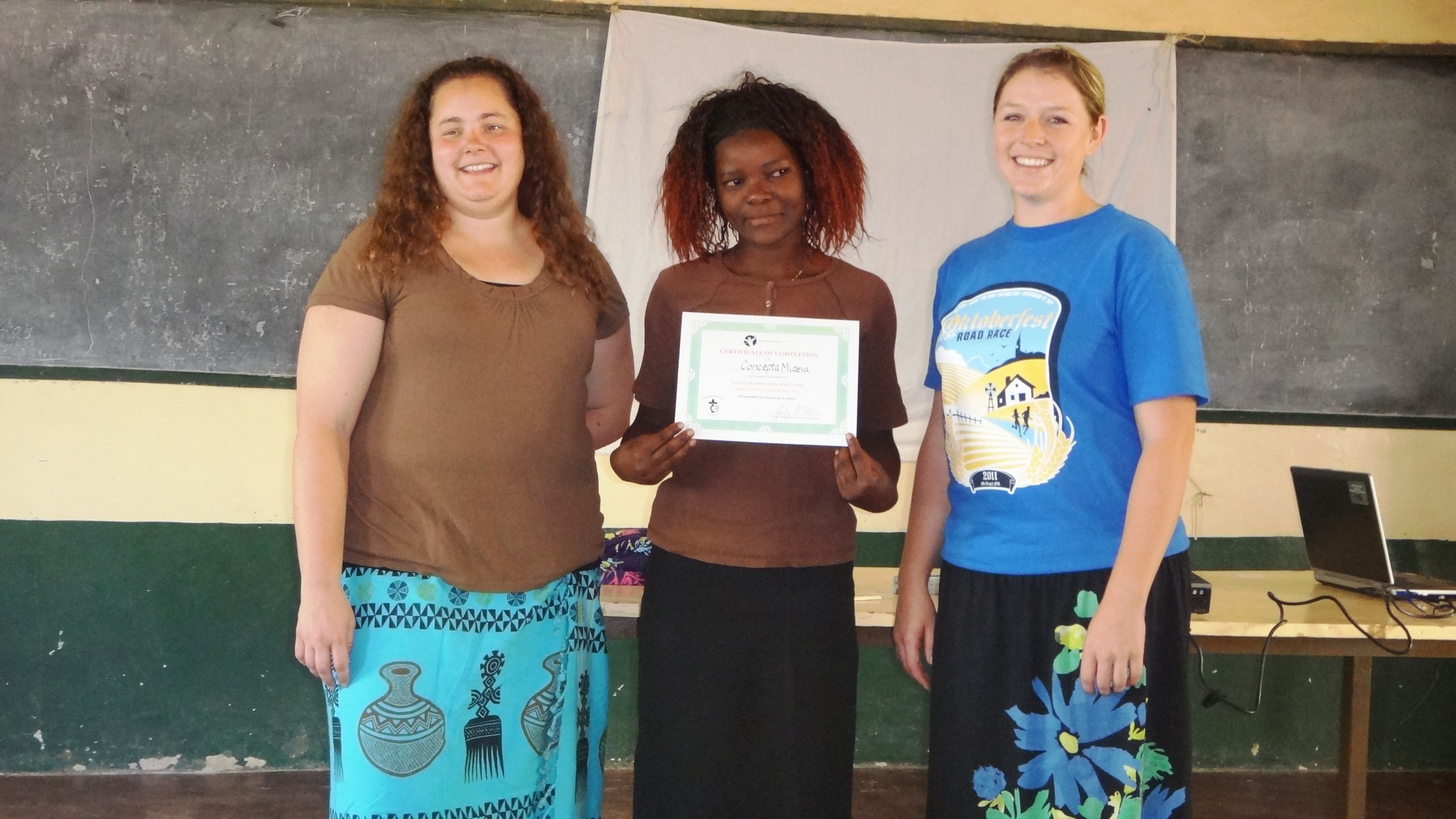
the training center. Her fellow classmates, who had also gone through the training, made a cot and quickly took her down the road to the clinic. It turned out that she had typhoid and they were able to treat here there at the clinic and she is now recovering. I wonder what would have happened if they hadn’t thought to take her there, if they had called for an ambulance and waited days, while she would have probably died. I know this sounds extreme, but this is what is their reality. It seems like such a miracle that we were able to be there, teach, and then see how helpful this could be.
The second story is about another student. He came up to me at the end of class. He told me a story about how last year he was following his friend on the highway and his friend’s car hit another. It was a bad accident and by the time he got up to his friend a whole crowd was gathering around. His friend was lying on the ground, bleeding to death. With all those people standing around, he included, not one person knew what to do. They were scared to move him, they were scared to touch him, and they were scared to do anything. So they did nothing and his friend died right there in front of him. He shook my hand and said, “I want to thank you, because you have taught me that next time I can help someone, and I can make a difference, I will know what to do.” I can’t tell you how much that tore at my heart, first of all to see what kind of pain these people go through every day, every year as they live their lives, but also how much hope they have that they can take that experience and now say to themselves that they are empowered and can move forward.


 NuttyGrass