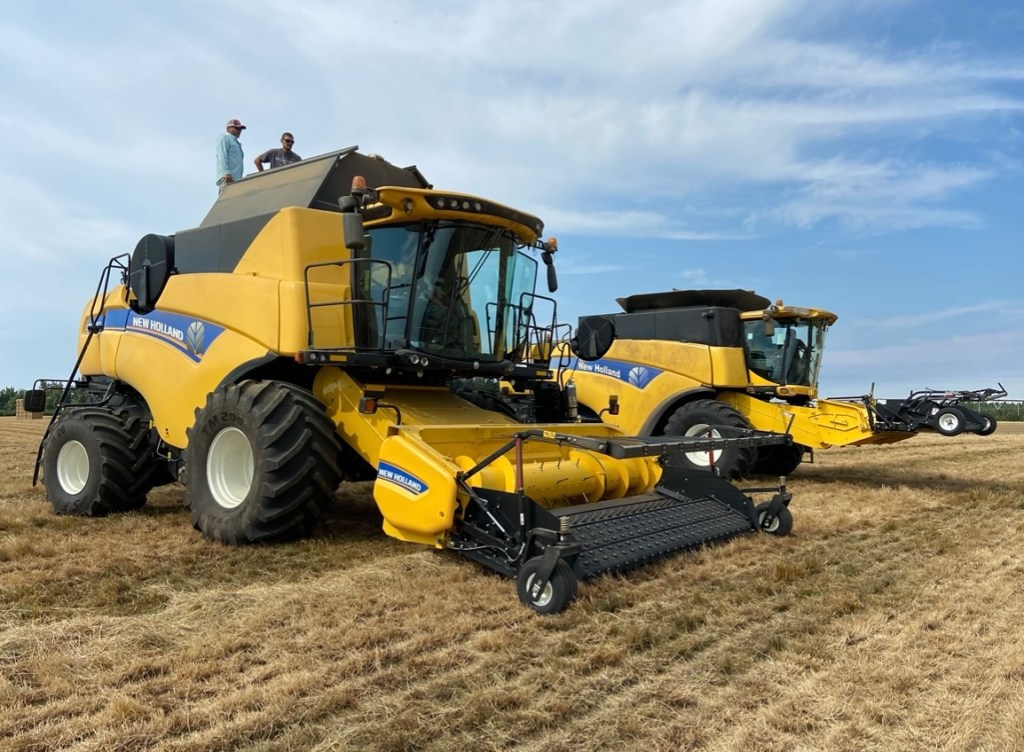
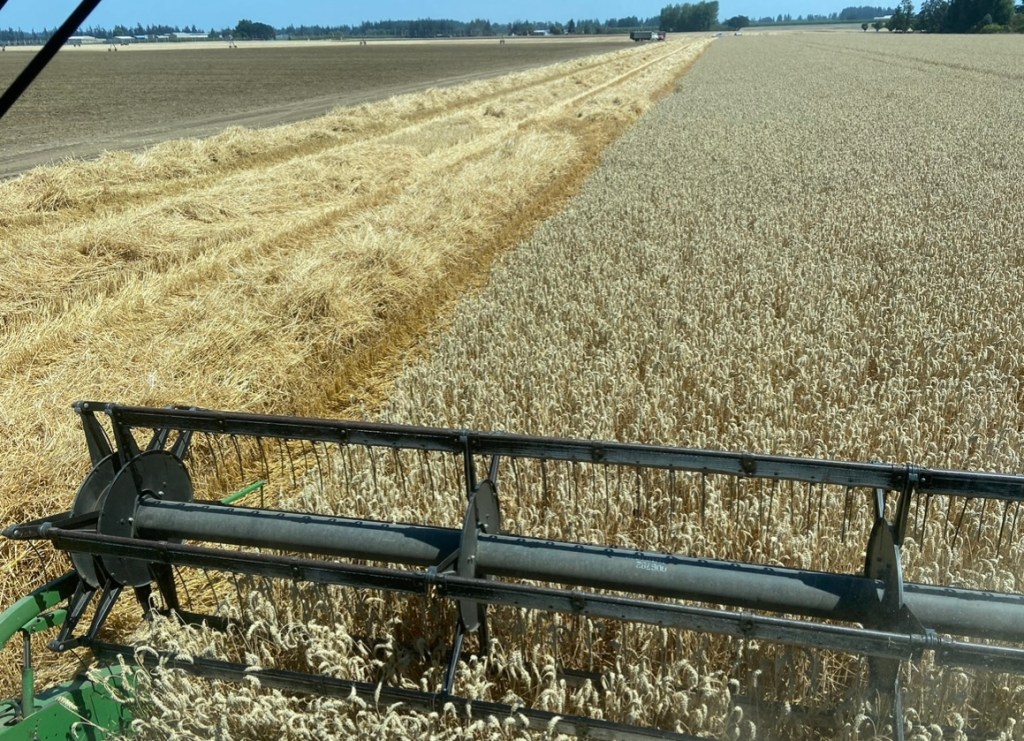
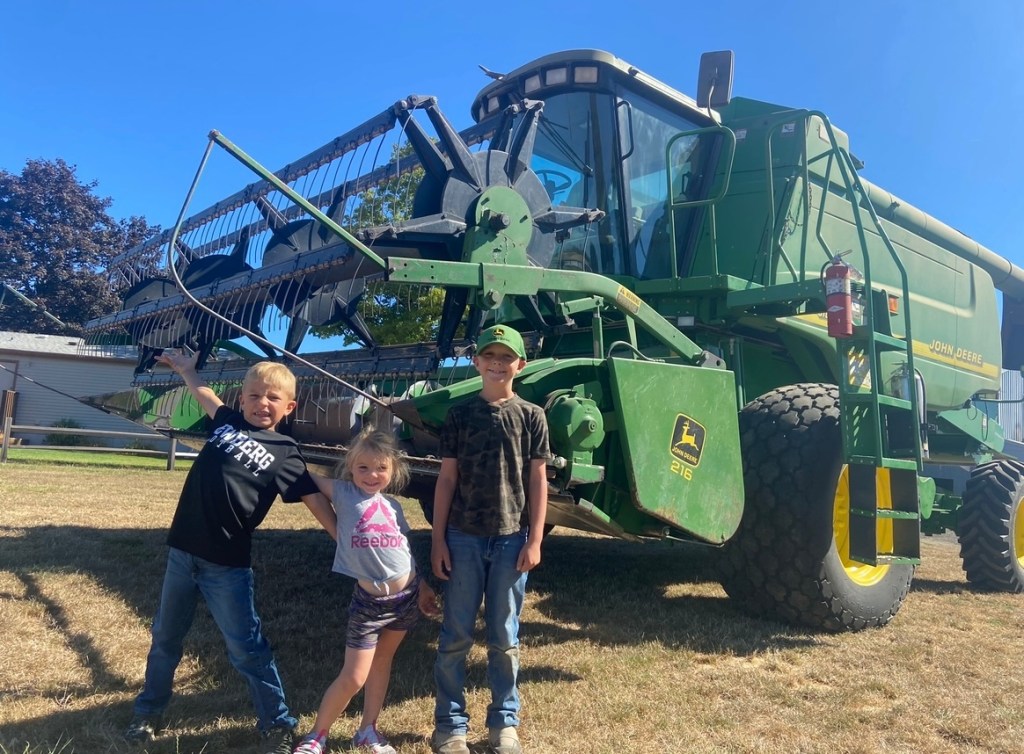
We bought a new combine at the end of harvest last year. So we are “retiring” our 9550 John Deere Sidehill combine. We went around and around on if we should just sell it, or do you keep it just in case, what are the costs, what are the risks, what are the holes that we would have, etc. So it felt like we went around and around so many times on this decision it felt that this post was appropriate to share. Enjoy….
If you buy a new combine, then you’ll have to sell the old one.
If you sell the old one, you will also have to sell the wheat header that goes with it.
If you sell the wheat header that goes with it you realize they don’t make tiny 12 foot wheat headers anymore.
And since they don’t make tiny 12 foot wheat headers anymore you’ll have to buy a 25 foot wheat header.
If you buy a 25 foot header you realize it won’t fit down the road like your 12 foot wheat header.
Since it won’t fit down the road like your twelve foot wheat header you’ll have to also buy a trailer.
Since you have to buy the header and the trailer you start to do math and realize it will cost you more than you thought.
Since it will cost you more than you thought you also think about the size again.
While thinking about the size again you realize your windrow coming out of the combine will be twice as big as the 12 footer.
If the windrow is twice as big as a 12 footer, you realize it will be too big for the tiny bale baler for the bales your kids sell each fall.
If it’s too big of a windrow for your tiny bale baler you realize you would have to spread the straw.
If you have to spread the straw, you then realize that you’d have to buy a set of rakes to then make the small windrow again for the tiny bale baler.
If you have to buy a set of rakes added to the cost of the header added to the cost of the trailer…. You think that maybe this could be too much of a pain
And maybe, just maybe you should just keep the old combine.
I recently was invited to come and speak alongside other farmers with a group of college kids. The college itself is one that initially I probably would have said no way. The reputation of beliefs at the school don’t at face value align with my own. However, after working with the professor on a few different projects, I got the sense and gained trust that his goal truly is to share different perspectives in a way that is not judgmental, but with the goal of reaching common ground and understanding. So I said yes.
I have to say it was great. I had to leave early, but as I left, I felt myself feeling like there was more to say more conversations to be had. We talked a lot about how can groups of people get so polarized and what the cost of that is, specifically in agriculture. I told them about some of the bills that we have fought in the legislature (some have passed and some haven’t), that some of those bills would close our doors the day they were signed into law. I wish that was just a dramatic story, but unfortunately it’s true. The positive side of that story is that the legislation didn’t pass, but my overall message was that misunderstanding or not having everyone at the table to discuss their side of the story (because let’s be honest you don’t know what you don’t know) can create unintended and serious repercussions.
This legislative session I went and testified on house bill 2548. It was a bill that at face value claimed it wanted to simply increase safety for our farm workers. But when you took a closer look, it actually was incredibly redundant, dangerously open ended and was going to cost our industry, not to mention do nothing to actually increase safety on farms. During the public testimony, there was a comment made by a legislator that she heard that while BOLI and OSHA have the regulations in place, they have no way to enforce these regulations. (Insert my look of shock here!) OSHA and BOLI have become some of the most powerful agencies in our state in regards to agriculture. We have found that that not only do they not know the law in many respects because they quickly hired many inspectors without extensive proper training, they also feel that they have the ability to use unchecked power to regulate our businesses with a heavy handedness that is unwarranted and unfair. The amount of time over the past four or five years that I have spent educating myself on rules and regulations in order to be able to essentially educate them when they show up on our farm has been exhausting. OSHA‘s fines alone in the past year have gone from an average of $1.9 million to almost $10 million. The heavy hand of enforcement is alive and well in the state of Oregon, believe me! However, the sad part is at some point a legislator heard that and never failed to go beyond to find the truth until we got to the point of a legislative hearing for this insane bill.
But as I sat there, I realized that that is why I’m glad that I said yes to going to speaking to those college kids. Because maybe someday one of them will be a legislator, a lawyer, an environmentalist, and one of them will reach out to me or have another farmer that they could discuss agricultural issues with or maybe they’ll just think back on our conversation and realize that there can be true repercussions so maybe they need to look a little further and ask a few more questions to find out what they don’t know or what they could be missing.
I think as farmers our lifestyle and our jobs generally lend us to be more secluded, less likely to interact or reach out to folks who maybe don’t have an experience with farming. We work hard. We take a lot of pride in what our hard work produces. I have to say that I didn’t want to go and speak to those college kids that day. It was on a day when I usually just lay low with my family before the very busy spring work begins. But as I was driving away, and then later as I was sitting at the Capital, I realized or maybe got a renewed realization that reaching across to the other side of the aisle is just ever so more important.
So this is my encouragement to say yes if you can to those opportunities. Have conversations human to human about each of your realities. You never know what it might produce, and at the very least a little understanding goes a long way.
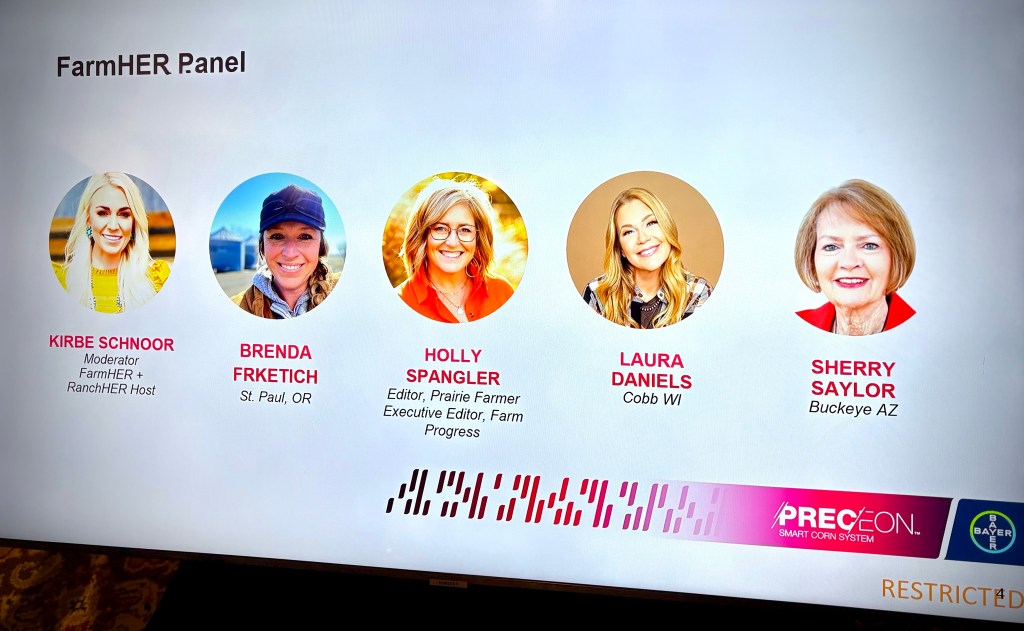
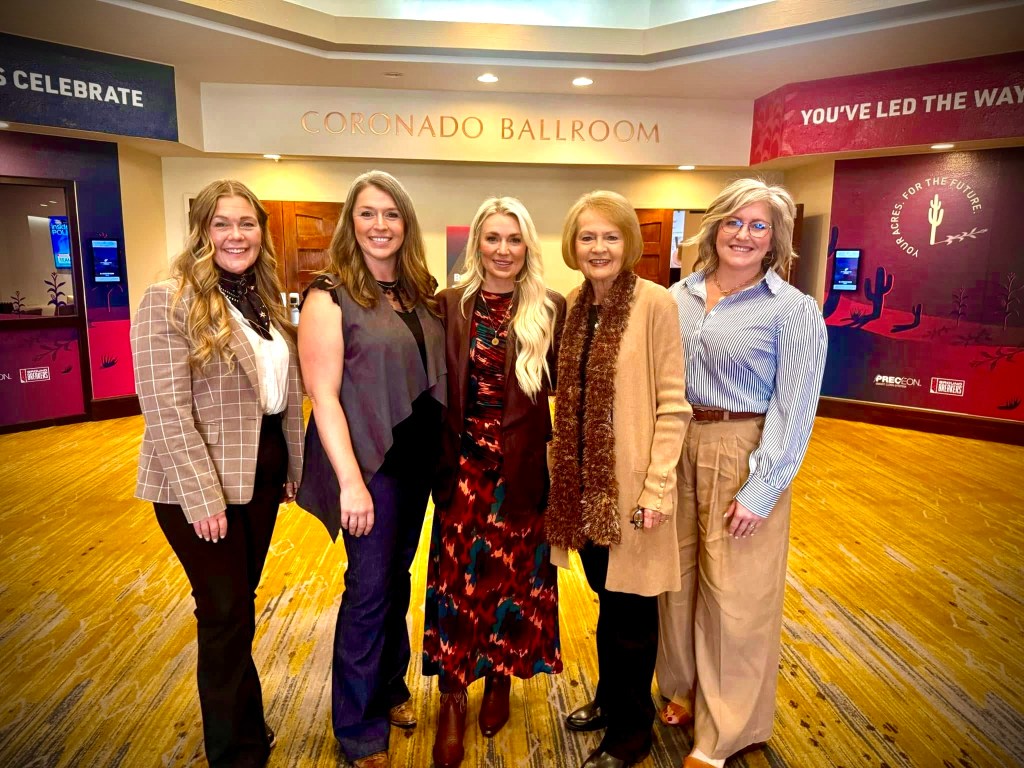
A month ago I took a quick trip (36 hrs) down to Tuscon, Arizona to participate in a panel to discuss farm wife life and all that comes with it. I was on a panel with Holly Spangler (Editor, Prairie Farmer & Executive Editor, Farm Progress), Sherry Saylor (Farm Bureau legend, school counselor and quite possibly the funniest person I’ve ever met), Laura Daniels (Hitch Pin Consulting & DairyGirl Network), and our moderator Kirbe Schnoor (FarmHer & RanchHer TV Host).
The panel went great, we covered a lot of heavy topics like work life balance, succession planning, farm life stress and how to manage it, and all that comes along with “just being a farm wife.” I say the “just a farm wife” jokingly but while I was on the way to the airport and chatting with my Uber driver, he asked what I was speaking about and I told him, “I was speaking on a panel to farm wives about challenges, succession, that kind of stuff.” and he responded, “Farm wives….aren’t all wives of farmers just farmers themselves?! I have never known anyone to live on a farm and not have a role beyond ‘just a wife!'”
He didn’t say it mean but he was for sure calling me out just a little, which is funny considering my adult life has mostly been talking about how we all have important roles, and how women have been “the farmer” for a long time but just never checked the box in the USDA survey to say they were. But anyhow it sparked a great conversation about women in farming, how things have changed from the days gone by and how women have always and still do play a very important role.
Laura, myself, Kirbe, Sherry & Holly
The panel was only an hour and I still sit here today weeks later thinking of things I should have added or could have said. There just wasn’t the time to cover all the conversations and discussion that a panel of farm wives could bring about. But I did walk away with some key concepts that really resonated with me.
One was from Laura Daniels of Hitch Pin Consulting. She brought up a great point that maybe it’s unfruitful and even overwhelming to strive for a true work life balance that is unattainable and usually is attached with guilt. She re-framed the term, “Strive to be present in what you’re doing. Wherever your feet might be, be truly there.” I love this point and as someone who is guilt ridden as the next mom it gave me a new way to look at how I’m spending my time.
While the discussion was moving along I thought in my head that this panel alone represents so many organizations, so much time out of the home. And then the conversation shifted to the fact that all of us with kids, different roles on the farm, some with jobs off the farm etc. Kirbe Schnoor (host of the show Farmher and moderator of our panel) brought up another piece of the puzzle, adding that while these ladies are hitting a season of life that allows for involvement off the farm or farm adjacent, it’s also ok to just be home with the kids and taking care of a household. It’s ok to be in the season of life to say no. Which hit very much home for me and allowed me to expand on the fact that 6 years ago I stepped back from everything, I paused pieces of my life that took me away from my kids, for five years I said no to it all. And then this past year I have slowly started volunteering again in a few different capacities.
From that point on in the conversations seasons were a big theme. Of the four of us sitting there we all had kids at different ages. We all entered the agricultural world at different times in our lives, and we all have a different future ahead of us. But looking at your “season of life” was something that we all worked hard to be honest with ourselves about, and I think that helps us all be more successful for where we are today. Life isn’t easy, but it’s easier when you allow yourself to be honest about what your capabilities are in that time period.
Along with seasons was another great point that no matter what point you’re at in your life, you always need a tribe of friends to help you through. Find people in your life who understand your mom life, understand your working life and fall on them when you need it. That community has saved me time and time again and I can’t say it enough that we all need help sometimes.
The panel was truly a joy to participate in. There were a lot of laughs and emotions, but I hope that other women walked away knowing that they aren’t alone in this life of “just being a farm wife” and there are so many of us out there that understand that it’s just not that simple ever. I’m thankful to Bayer for recognizing the need for networking and having time to connect with other women. I’m also very excited for the number of women that I met that I’m sure I’ll run into down the road at other ag and farming events, always great to have friends all over the country! And lastly I learned a very good lesson, if you end up getting the chance to go to sunny Arizona in January, stay for more than 36 hours!





 NuttyGrass