A blog post came to my attention this weekend and as I was thinking about what to blog about this week, I thought why not give a response to the many people who have asked me about this. Is it true? What is going on? Is this just crazy talk? The blog post basically says that farmers are spraying wheat days before harvest with Round-up and therefore injecting poison into our food. Here’s the deal though, we aren’t doing that at all!
At first I thought I would just write a comment, but as the time went on and more comments posted, I realized that would be a waste of my time. Because as every farmer or person was involved with the ag industry posted that this wasn’t a practice that wasn’t commonly used, the author of the blog just continually called them all liars. Saying things like, “Do you really think a US wheat farmer is going to come on this blog and say, “YES, I’m doing it! I’m one of the ones poisoning your children!” So deciding that it wasn’t worth my time to hang out on her blog with my comments was an easy one. So here are a few answers to the most common questions I have been getting…
Is this a common practice among US farmers? No absolutely not!! I have never even heard of the practice before this blog to be honest. But after doing some research it seems as though there are a small fraction of farmers who do use this application. It is done with specific timing and in the allowed 7 day pre-harvest interval that is allowed on the label of round up. But again I want to make sure you all understand, this is NOT widely done at all! We have never used Round-up as a burn down product.
But even if we did…does it add more seeds and thus more profit? No, not at all. The crop for wheat is determined well before 7 days before harvest. The entire process of growing the crop, from time of planting, application of fertilizer, how clean your field is to begin with, how well you have taken care of your soil, and even applications of fungicides will change yields. But an application just days before harvest would do nothing to add to the crop, the yield is already set.
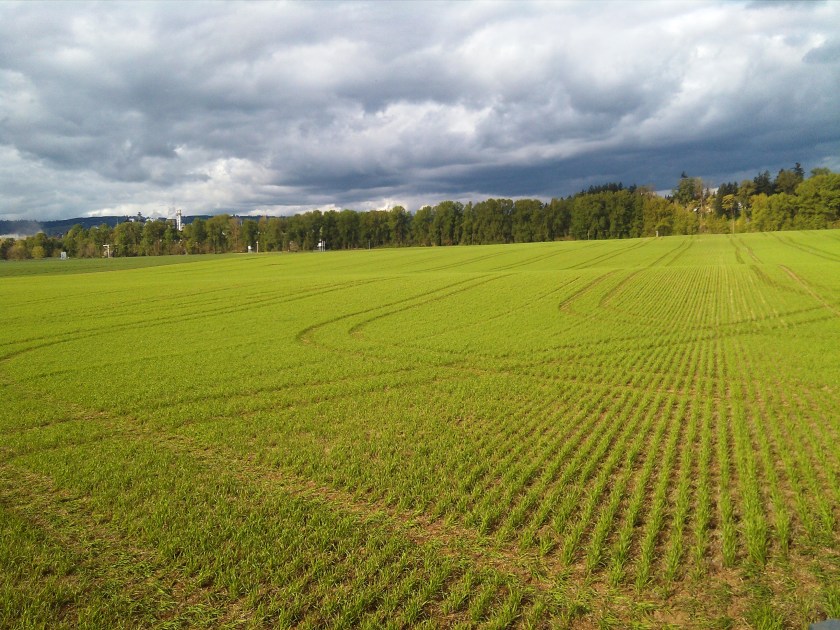
Is it labeled…or is it illegal? The practice is labeled with a 7 day pre-harvest interval. This means that as long as you spray 7 days before harvest, you are within the label guidelines. Also the label states that it is to be used as a way to control weeds prior to harvest. I’m guessing, (since I have never used it for this purpose I can’t be totally sure) that is helps kill the weeds that are growing in addition to the crop. When you a lot of weeds growing under it may inhibit harvesting easily and cause issues with your combine. Which would make sense to me if that is the issue that you are up against. So yes it is legal and allowable per the label.
But what does a label really mean? Now some of you may say…”Well farmers don’t follow labels, it’s just a piece of paper right?” And labels may not mean much to those who don’t farm. They may just look like a booklet that is taped to the side of a jug. But as a farmer I can tell you that I read labels everyday, I follow labels every time that I spray. These aren’t just suggestions, these are the rules that we abide by and we are held to our departments of agriculture. They are rules that they take seriously, and I as a farmer who wants to be safe and provide safe food, also take very seriously. To get these labels companies have to do extensive research on residuals, timings, effects on crops, etc.
In the end I hope that people will see this blog for what it is…a way to spread fear about conventional farmers. It’s so obvious with the use of words, “tears of horror”…really? So let me put your fears aside. I want to tell you a short story about how we check our wheat before harvest to see if it’s ready, and also during harvest to make sure that the moisture is right. We grab a handful (with our bare hands) and we toss kernels into our mouths and we eat it. This practice has been done for generations. My grandpa ate wheat straight from the field, straight from the combine, my dad has, and I do as well. You would think that if anyone is going to come away from this whole conventional wheat experience with a toxic disease it would be us…but we don’t. We are all healthy as horses, because what we are growing is safe and healthy. Now I know as much as anyone that this isn’t scientific, but it does show how much we trust what we are doing out here in the fields.

So why is this even worth my time in blogging? A small reason is because I am sick and tired of reading about all the awful things that we do as conventional farmers, without having a voice to show them that they are wrong. But mostly it’s because I am proud of what I grow on this farm of mine and my family has been proud to do what we do for generations! I have continued the legacy of providing safe food not by trash talking anyone else and trying to make others look bad who may not use the same techniques as me. I provide food in a way that I know is safe and I grow good food because it’s the right thing to do. I know it’s safe because I sit in hours and hour of classes listening to research from our industry (not from Monsanto but from independent researchers). I spend my time, just like other farmers, doing my due diligence and making sure that we are doing this right; that we can send our crop off to the processor with no worries.
I am a regular person, I am a mom, a wife, a daughter, and a farmer; accusing me of wanting to harm people with the crops that I grow is just plain ridiculous. I wouldn’t be able to hold my head high in pride for what I do if I couldn’t back it up. If this blogger wants to come take a trip to my farm and see what we’re up to a few days before wheat harvest…come on out! I guarantee you will see a sprayer sitting in the barn, and us working extremely hard for the past 3 months harvesting 14 hours a day seven days a week just to get our crops in. But like I said, come on out…we would be happy to put you to work and show you some of the realities of our farming practices.
If you have more questions or comments please leave them below. I will be happy to answer what I can and if I can’t, I will be happy to do some more research and find answers. Thank you!
For more information you can check out these links:
Nurse Loves Farmer
Peterson Brothers Response


 NuttyGrass