Out with the Old and In with the New….Filberts

I would just write everyday about how it’s still raining, but that gets old for all of us. So instead I thought I’d share about what we did on that one day that it didn’t rain…I know you all remember it a few weeks back. We planted new filbert trees! Actually the more accurate term would probably be replacement trees because the last few years we have stopped adding new acres of hazelnuts (often referred to as filberts) here on our farm and instead are removing older varieties and planting new baby trees.

Our older varieties are Barcelona and were planted back in 1990. This was before blight was really a big “thing” in our area and not something that we had to work very hard to control or manage. That has changed a lot in the past 30 years and with new tree development from Oregon State University we have newer varieties that are resistant to the blight that we are currently having to control in our older trees.

By controlling I mean the use of heavy pruning each year and also fungicide sprays multiple times per year. In turn the new varieties help in reducing labor costs and also the use of fungicides. It’s not quite a win win however because you’re taking down a tree that has been producing an income for you and replacing it with a tree that will take years (usually around 4) before it is producing enough crop to harvest. Meanwhile we are still caring for and nurturing that tree, which all costs money.
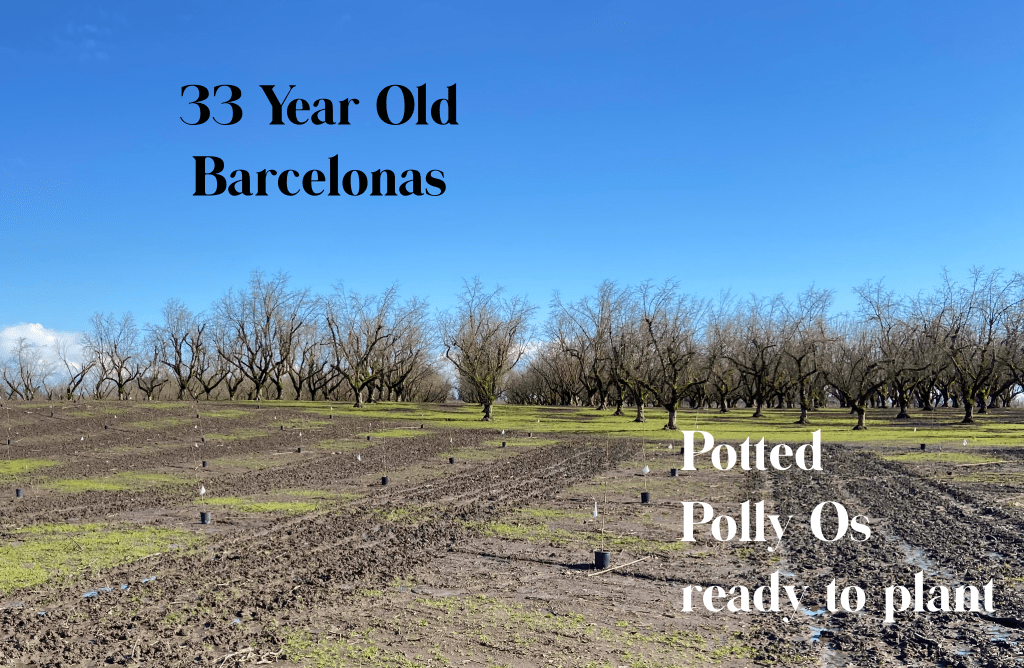
We have been slowing chipping away at our older orchards. This planting is only 13 acres and will start to get harvested in the year 2026 or 2027. The variety of tree is Polly O’s along with a handful of pollenizer varieties mixed in as well.

We are planning to wait for a few more years before we take out the final acreage of Barcelonas, they are still producing well and while they take a little more care, it economically makes sense to wait until a few of our newer trees are making some income before completely taking everything out. It’s always easy to make an excuse to leave trees in that are producing nuts because when the price is high you need all the nuts you can get, and when the price in low you need all the nuts you can get….see what happened there, there is no good time when looked at face value, but when you sit and calculate the costs, there comes a time when you just have to move forward with a new variety.

We have had a few more days of drying the past couple of weeks and we are slowly chipping away at getting our crops fertilized, planted, and weeds killed; but it’s been frustrating so far this year. Time will tell what this all means for all of our bottom line, until then we will keep chipping away hoping for more sunshine!

Two of the busiest days in farming

Farming is very centered around things that are out of our control; and I put weather very close if not at the top of that list. So it probably doesn’t surprise you that what makes a farming day busy is a direct correlation. Day 1: when it starts to rain. Day 2: when it finally dries out.

Day 1 is usually in the fall. We are waiting for rain to help water in chemical to keep our fields clean, we are planting in hopes for some good rains to give it a good start. We are working fields to get some moisture to help break up the clouds that don’t allow for a good seed bed. The day before it starts to rain in the fall is usually never long enough to get it all completely done; but that doesn’t mean you don’t work your tail off trying.

Day 2 hits in the late winter – early spring. the day that fields are finally dry enough from the wet patterns of winter weather. There is fertilizing, planting, spraying, spot spraying, strip spraying. The day the soil dries out enough to not get stuck, you wish you could go 100 different directions all at once.

The Triage of Fall Farming

The Triage of Spring Farming

So as spring break starts around here for our kids it looks like we also may be getting a nice stretch of drier weather to allow for possibly a window to get as much caught up as we can. Last week as another thunder shower poured down outside my office Matt and I were discussing how the most frustrating thing about it all is knowing that you’ve done all you can and yet the day it dries out we know that we are instantly behind. That’s farming for you!

Getting ready because it has to dry out someday!!

It’s been a wet and cold start to spring so far this year here in the Willamette Valley. But things will warm up and we will be harvesting before we know it. Time will tell if it’s going to be a late start to harvest though, I know there are a lot of very small sized crops out there, and a lot of that can be contributed to the fall rains that didn’t come until very late. It’s all connected, it’s all a cycle and we just have to keep rolling on getting as much done to prepare to be able to execute on those two busiest days of the year!

Oregon Grass Seed Research Roundtable

I often think in the back of my head that as farmers we really are never doing things the way that we have always done them, mostly because I’m constantly reminded when I talk to non-farmers that is what they assume. I’ve written before about how farmers are always “Doing what we’ve always done – NOPE!”. Last week I had the privilege of attending a grass seed research roundtable at Oregon State University. This is the first year that one has been held here in Oregon specific to grass seed. The room was full with over 30 stakeholders and another dozen or so logged in through zoom. Another reminder to me about how forward thinking and solution oriented this industry here in Oregon continues to be; which I love!

If we’re honest I think we can agree that research isn’t the most riveting topic most time, but the set up of this roundtable allowed us all to hear a summary from the researchers, limited to 10 minutes; enough time to summarize but not get too deep in the weeds of research which can put even the most nerdy farmer asleep (no offense to those in research). Which was followed up by 5 minutes for questions from producers, seed dealers, field-men, and other researchers.

Topics included many of the pests that we are constantly battling in the field and other challenges that we face as producers and as an industry as a whole. Voles, billbugs, symphylans (research to help off set the gap in control that the Lorsban/chlorpyrifos ban left us with), DNA testing for seed, field residue and pre-emergent sprays, optical seed sorting, weed management and smart sprayers, crop stand longevity, straw management and what that means for our soil and carbon sequestration, nitrogen leaching potential, and on and on.

They say that the definition of insanity is doing the same thing over and over again and expecting a different result. It’s no different in the farming world. Sitting there last week was a continuous reminder that our industry is always changing, adapting and finding solutions. As a solution oriented person both in my personal life and in my farming life, this was all very exciting to me.

Now comes the tough part of ranking them all for funding; research doesn’t come free but the knowledge that we will gain from these trials will pay time and time again for this industry here in Oregon. Last week was just another reason I’m proud to be a grass seed producer here in Oregon.