
What crops are GMO’s? This question I’m guessing is a very popular one. I’ve personally typed it into Google a number of times, I’m sure there are many others out there who have too! So it’s not surprising that even our local grocery store might be a little confused. There was an ad that ran in our local paper last weekend. It was from our local grocery store, Fred Meyer. In the ad were a few things that looked “off” to me. A photo of the ad is below, can you see what I’m talking about?
 Yes, GMO Free herbs, GMO free vegetable plants are both listed as for sale at Fred Meyer…well yee haw what a deal right?! Finally some options of where to get your GMO free gardening plants, but wait…there is no such things as GMO herbs and there is no such thing as GMO tomato plants, lettuce, onions, egg plant, peppers…. So what the heck Fred Meyer? What’s with the misinformation? Are you trying to confuse consumers more? As a consumer do you feel duped? I’m going to throw it out there that I don’t always remember exactly which crops off the top of my head are GMO, so here is a quick reference. Currently there are only ten, and while they extend into many different food items, there truly are only ten crops that are GMO, (a few as you can see that will be out there and more available this year).
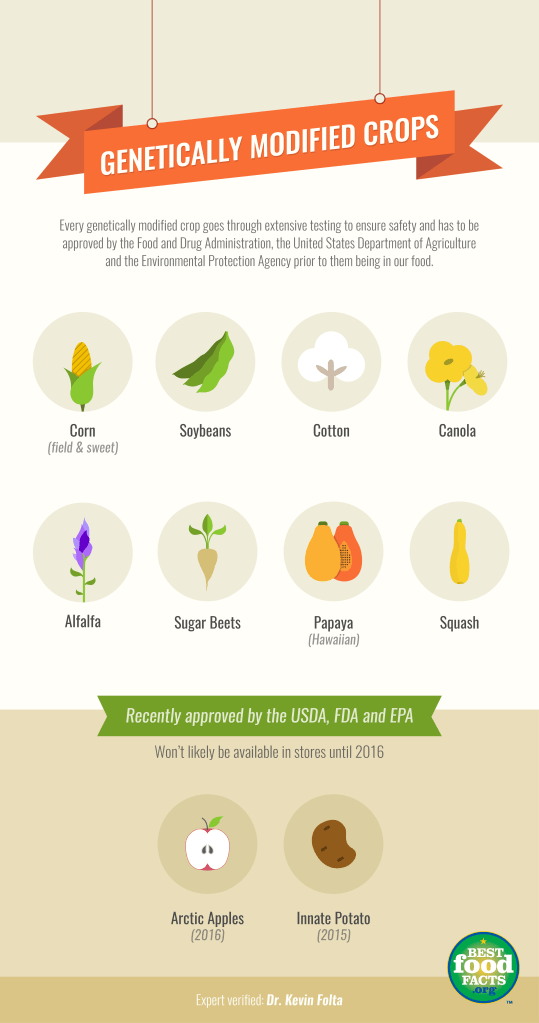
I’m not upset with Fred Meyer. Maybe this was an honest mistake, maybe this was a marketing ploy, maybe this was…well I don’t know what this was to be honest. But I think that if you’re going to be a source for people to buy their food you have got to take some responsibility for the type of marketing and messages that you send to consumers. Consumers (I would include myself in this category) while feeling the need to know what is in their food and what they put in their body are overwhelmed with fear marketing, misinformation, and shoddy science. So who do they trust? Who can they turn to and in a convenient place, why not the grocery store?
In my perfect world, companies that are trusted, such as your local grocer would speak up about GMO’s, they would do their due diligence to look at the science and share that with their customers. I feel like more and more companies are running scared from losing one sale to a small percentage of people who are believing the fear of Food Babe and Dr. Oz, before they even have a chance of learning the truth behind the science.
I feel like a broken record at times, but folks it is going to take ALL of us to feed the people in this world as it grows and grows. It is going to take science, technology, organic, conventional, small and large farms to get food to our tables, so why not help be a proactive participant in that process? Fred Meyer, I’m calling you out a little here, take this chance to start a conversation, be a reliable source, not just one that jumps on the bandwagon of fear marketing, but one that consumers can trust.
For some good reading on the science of GMO’s check out these sites:
Take the GMO Quiz: How much do you know?
10 Things you may not know about GMOs
What is a GMO and Why Should I Care?
Q&A with Simplot Scientist Nicole Nichol
Did you Know Insulin is a GMO?
The Biggest Concerns about GMO Food aren’t really about GMO’s
Bacteria Made Natural GMO Sweet Potato
There is a distinction between GE (Genetically Engineered) and GMO (Genetically Modified Organism). Because the term “GMO” is more familiar with the general public, I am choosing to use this terminology in this blog.






 NuttyGrass