I know that I have touched on this before, but it’s something that for me I never knew until I become a year round full time farmer. I truly believed that farmers did what they have always done because they have always done it. And for some things that is true, the tradition that you have with farming families runs deep. But I think there is a strong tradition of innovation and learning that comes along with that, one which gets overlooked many times. As a farmer many times I feel caught between this old fashioned view that people have of the management of our farms, and this forward thinking industry that I’m living and breathing.
Last Friday I wrote about how farmers are always learning and continuing their education. And yes, as I was called out on Facebook for writing that blog during a meeting, but I only missed 10 seconds of the speech I promise! 🙂
During the winter there are many decisions to make. Many times planning comes into play, and since we grow more than just corn and soybeans out here (Oregon grows as many as 250 different crops!) it’s not just about planting timing and budgeting for one or two crops. It’s figuring out rotations that work, ones that don’t work, budgeting for crops and trying to foresee what could come up with each one. And with all of that, going to meetings this time of year is essential to keeping up with what is happening in our industry. Helping with everything from business and labor decisions to what crops to plant and how to manage them.
Just last week I attended a meeting hosted by Oregon State University. They were talking about availability of certain chemistries that we have relied on in year’s past, what our options will be this spring and how to manage those decisions. They also touched on varieties of spring wheat to plant, pros and cons of each. And as we are looking at about 130 acres of spring wheat to plant in just a month this was imperative information. And in many of these meetings we also talk about what are ways to do more with less, what are the timings of applications that make them do the best they can for your crop, etc.
This winter I will also be attending an AgChat convention up in Portland. This is just another part of moving our farm closer (via social media) to our urban neighbors and learning more about what they want to know about us farmers out here in the country. Being a farmer only just 30 miles from Portland, it interests me to know what I can do with social media to make my story heard by more people, and let people know what we are doing out here on the farm and that we’re proud of how we take care of our land and soil.
So like any industry, including medicine and computers, we have to be keeping up with the times and moving our business practices and farming practices forward. Whether it be new tools to help keep our fields growing stronger, new marketing techniques and ways to reach our customers, or new GPS technology that allows us to do more with less. Anymore it’s not just about putting a piece of straw in your mouth, throwing on a straw hat and working the back 40. We put the piece of straw in our mouth, put on our straw hat and use GPS to drive our tractor for us now on the back 40…small but significant difference. And in all aspects, it’s learning constantly and moving forward with all the changes that will keep us viable and farming many more generations to pass on those strong held family traditions of blood, sweat, tears and dirt.
Like what you read? Share it here...
 Hazelnuts take about 4 years to get large enough and have enough crop on the trees to make them worth harvesting. So instead of letting our ground sit with no crop on it for 4 years, loosing income, we inter-plant. In years past we have done a rotation of wheat, followed by crimson clover, then followed by one more crimson clover crop. After that the trees are a little too big to get into the field with the larger equipment necessary to harvest the inter-crop.
 It does get a bit tricky at times, with ways that you can manage the trees alongside another crop. But we have found that these two crop types, wheat and crimson, do a very nice job. Beyond the economics that you can get a little income off your ground for a few years, an added benefit is that you don’t have to spray for weeds on the bare ground for 3 years, with a crop on the ground it will help shade out unwanted weeds.
 This is a photo of our first wheat crop in between hazelnut trees 5 years ago. The major change was that we had to swath (cut down) the wheat instead of harvesting it while it was standing. This was because our wheat header was too big to fit down the rows. At our farm even with 1000 acres to work with, just loosing 27 acres to a crop that won’t be harvest-able for another 4 years puts us in a pinch. So we do what we can to make sure we are utilizing the land that we have.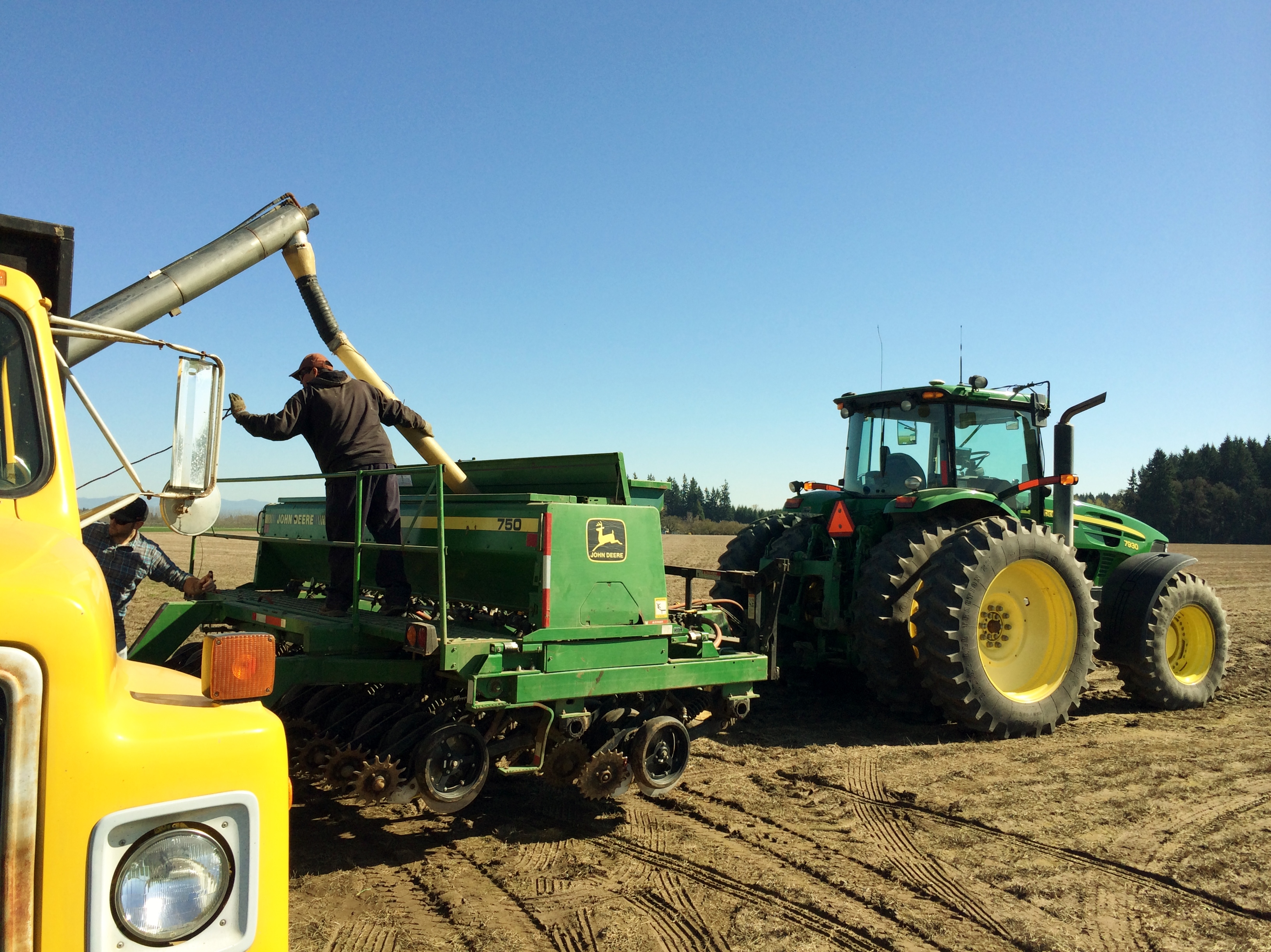


 NuttyGrass