There was an article last week in the Statesman Journal entitled, “Farmers get hate mail, harassment for opposing GMO labels.” There has been a lot of talk about this since. I’ve gotten questions, people have apologized, I’ve even heard rumors that we got death threats. So I wanted to clear up a few things.
First of all it is true that my husband and I both received hate mail. I got blog comments and emails that were less than friendly in nature, really awful in some respects. I was told that I was poisoning children, they hoped my farm failed, etc., etc. So yes, the article was true in that fact. But what I think the article should have been about, more than hate mail from people who don’t agree, was about the recognition that we all received from Oregon Farm Bureau for standing up even though we knew that getting called “sell-outs” was a possibility.
I honestly can say that I said yes to working with this campaign knowing that food is an emotional issue. It’s one that people talk about everyday, they are enthralled with, frustrated with, trusting of, and at the same time skeptical of what our food system is today. So I knew what I was walking in to and I half expected to get some type of backlash.
Here is what I didn’t expect. I didn’t expect to get so many thank you’s from people I have never met. I didn’t expect that every time I walked into a meeting with people whom I respect to have them shake my hand in appreciation for standing up. I didn’t expect to have so many people come to talk to me, just to hear more about this issue. I knew that it would open up conversations, but I never knew how far that would go. And I truly didn’t expect to be recognized by Oregon Farm Bureau in receiving their annual Service to Agriculture for my courage during this campaign. I am truly honored by that.
So while the article didn’t get any comments from us hate mail receivers (wish they would have at least tried to contact me) I wanted to give you my view from the inside looking out. It isn’t always the whole story when you receive hateful messages, as one of my friends put it, “If nobody is angry with you, you likely haven’t accomplished anything.” (Thanks Josh!)
On the ballot in Oregon this year is a measure that is of particular interest to me. Not just because I’m a farmer, not just because I’m a mom, and not just because I’m a consumer who buys food here, but a mix of all of these things that make me who I am creates an interest in the GMO labeling issue. Let me start by saying that I am against labeling here in Oregon. And it’s not because Monsanto is paying me to say that, it’s not because I’m a GMO farmer, and please don’t comment on here saying exactly those things. I’ve been called too many horrible things from people who have a different opinion than mine because of the public stand that I’ve taken on this issue and here is not the place to bring on useless insults.
I’m against labeling because it truly doesn’t make sense for our state. The yes side claims that 64 other countries label their food, and their food prices didn’t rise because of it. Well I have tried to find the study and I haven’t been able to, but I question what they looked at when they did this study. First of all it was done of the “countries” where labeling has become law, but did they look at the impact it would have if just one state in that country would have tried to do it? Did they take into account the cost of food to begin with? In the US we have one of the cheapest and safest food supplies in the world, maybe other countries have more favorable margins that allow them to add a label and not cause the end result to be a higher food price for others. I also would question how many of these countries have actually put these labeling laws into effect and actually monitor them? I know for a fact that not all of them do. I would also question how their labeling laws look in comparison to the one on the ballot, which to me makes no real sense at all. Too many questions with the country argument, to me, it’s moot.
Then there is the argument that it includes all foods and the No side is lying when they say it doesn’t. Well, we are saying that because, it doesn’t. It doesn’t include animal products because they say that when animals eat the GMO’s it doesn’t become part of the animal (why then are they so scared that they are going to become part of us when we eat them?). But then they include things that are made with sugar, a product that while grown in a GMO sugar beat, in the end has no DNA when added to food, so how could it still contain the GMO that was inserted into the DNA? Same situation with soybean oil and GMO soybeans. Even better is the pop that you buy at the grocery store that will have to be labeled, but then if you walk across the street to the 7-11 to buy it, it wouldn’t need a label…hmmm, yes this is getting confusing…I agree!
So what if you do want to know what is in your food? Well as someone who does want to know, I understand, and I have the answer for you! All you have to do is buy products that are already labeled through a national labeling system that we already have in place. If you buy organic or non-GMO project verified, those are both guarantees that the product you’re buying doesn’t have GMO’s. It is true that yes, these products cost more, because they have this label on them and people who are concerned for whatever reason about eating anything other than organic can pay the higher price for it. For the rest of us, the rest of us who understand the safety of food that is conventionally grown, let us keep our lower cost of safe and reliable food. Why would you want to increase our costs for a label that study after study has confirmed that GMOs are safe to consume?
My last reason is one that has just come about in the last couple of weeks, with the addition of the new commercial from the yes side. We’ve all seen it, where the EPA guy is holding up blue corn and regular colored corn. And those of us in the agriculture industry know exactly what he’s holding up, it’s corn that has been treated so that it can be planted and fend off any pests while it sits in the ground waiting to sprout. So as a farmer I’m sitting there wondering where he is going with this, because blue seed has absolutely nothing to do with whether the seed is GMO or not! Not to mention the fact that it’s seed, seed that is planted to then produce the food. You don’t eat the seeds folks. But then of course he starts to talk and confirms my fear, he thinks somehow that no one will ask the question, that we will just trust him, that those blue corn chips you’re eating, yup you guessed it…they are covered with 5 toxic chemicals…but wait they aren’t!! Like I said, seed treatments have nothing to do with GMO at all, they have nothing to do with the food you eat at all!! So if you’re making your decision on that commercial in any sort of way please don’t. This is a gross use of media to spread fear about our food in a completely misleading way and it’s quite frankly infuriating to me as a farmer and insulting to me as an intelligent person. (By intelligent I am referring to the fact that I understand how food is grown…this is not rocket science here folks)
I think that it’s safe to say this campaign in Oregon isn’t just about Oregon. You can see from who has contributed to both sides that this issue is of national concern. And whether people here pay more for their food or not is really of no concern to those who are pushing the issue. Those who want to use fear and blue seeds to scare you into making a decision that we will regret. The end game for the yes folks is to get GMO technology banned and to take away tools that make modern day agriculture look like the villain. When really 98% of us are just family farmers who are growing safe food that we too feed to markets as big as world markets and as small as our own dinner tables with our own families. So when you sit down to fill out your ballot take a moment to really think about what the costs might be. Maybe you can afford higher food prices, and because of that maybe you do buy organic and maybe that is your way to continue to have GMO free food. But maybe there is also room for the rest of us to have the freedom to buy inexpensive food that we too enjoy. There is room for different markets here in Oregon, conventional farmers, organic farmers, local farmers, etc; and I think that we need to encourage that balance to continue to be a strong state in this great nation.
Below is my commercial that you may have seen, I hope that maybe watching it again will make you realize that I am sincere, I do care, and what I say in this short commercial and in this long blog post means a lot to me and my legacy of farming here in Oregon.
This past fall I testified on behalf of a measure at the Oregon State legislature that would distinguish legislative control over what farmers in Oregon can and cannot grow be left at the state level. The reasoning behind the need for seed pre-emption is a lengthy one but comes down in the most simplest terms that there were a few counties who were trying to ban the growing of GMO crops. They were trying to put the burden of enforcement on county governments, who can’t afford the costs that this would bring. But beyond that, they were taking away farmer’s rights to use technology that has been deemed safe time and time again.
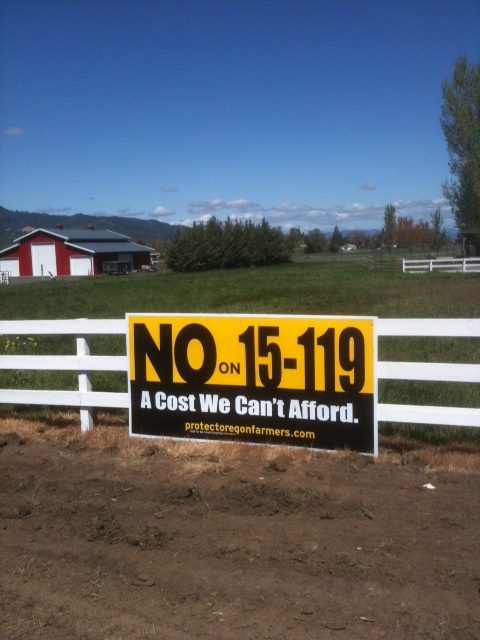
The measure was passed in a special session package that was signed into law last fall. The only exception was Jackson county, who had already gotten the signatures required to get a ban on growing GMO crops on their ballot this spring. Here in lies the local issue, a local issue that if passed would not only hurt the county where it passes, it also hurts the farmers who are trying their best and growing safe food for the world while limiting their options for what to grow. Plus this could bring statewide changes, and that is something that as a farmer I don’t want to see.
But the main reason that I bring up this issue is the part that makes me the most frustrated…it’s pitting farmer against farmer. I have heard time and time again from people I know who live in that county, “We heard that the farmers are for this measure.” The truth is that only one part of the farming industry is behind this measure, the ones who are out to destroy conventional farmers who have also been in the area for generations making their living off the land. There is room in agriculture for all types of farmers and it’s going to take ALL OF US to feed this world into the future. So without trying to sound too cliche, why can’t we all just get along? Why can’t we work together with our neighbors and figure out how to all coexsits?
I think that this is an issue that won’t be going away soon. With labeling being a huge conversation in the talk of GMO at all levels of government, not to mention state initiatives that are being put on ballots across the country state by state. But let’s not all lose sight of the fact that farmers are out there working their butts off to feed their family, their employee’s families, and people all over the world. So why would we want to limit our ability to do just that by breaking up regulations on a county by county level, or even as a state by state ruling?
You can see what efforts are being made right now by checking out the No on Measure 15-119 facebook page.
 NuttyGrass