Ice Storm hits Oregon

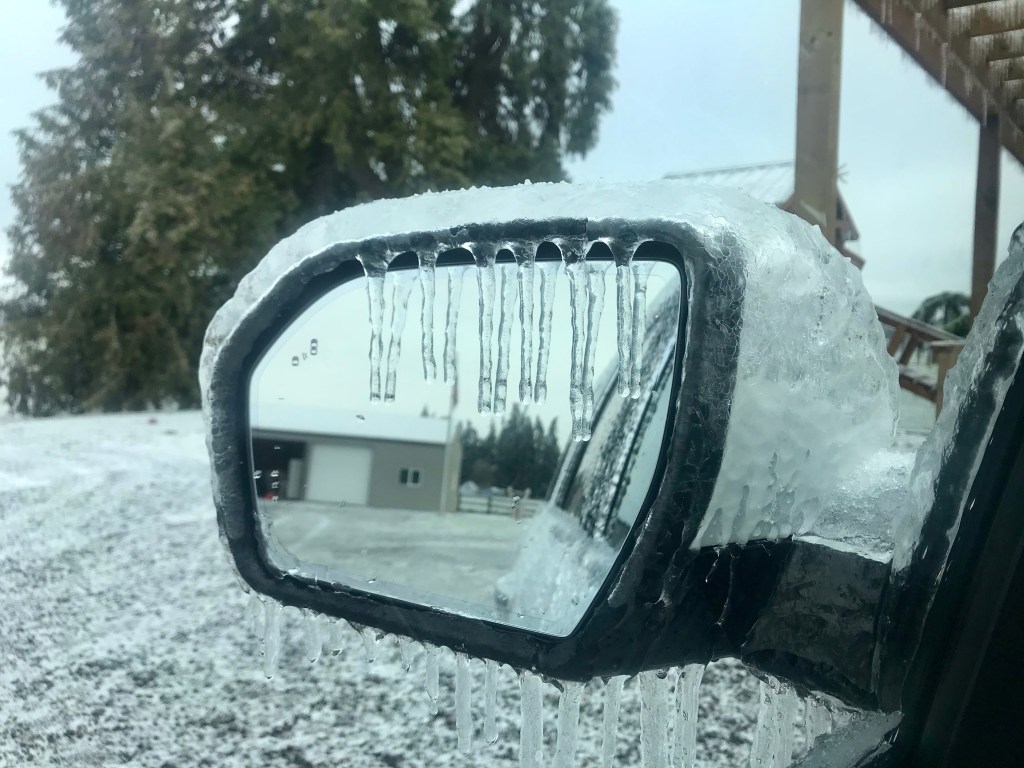
A few days ago an ice storm hit Oregon with a blast of cold and precipitation that resulted in a pretty major ice event. Hundreds of thousands of people are still without power (including my family and the farm).
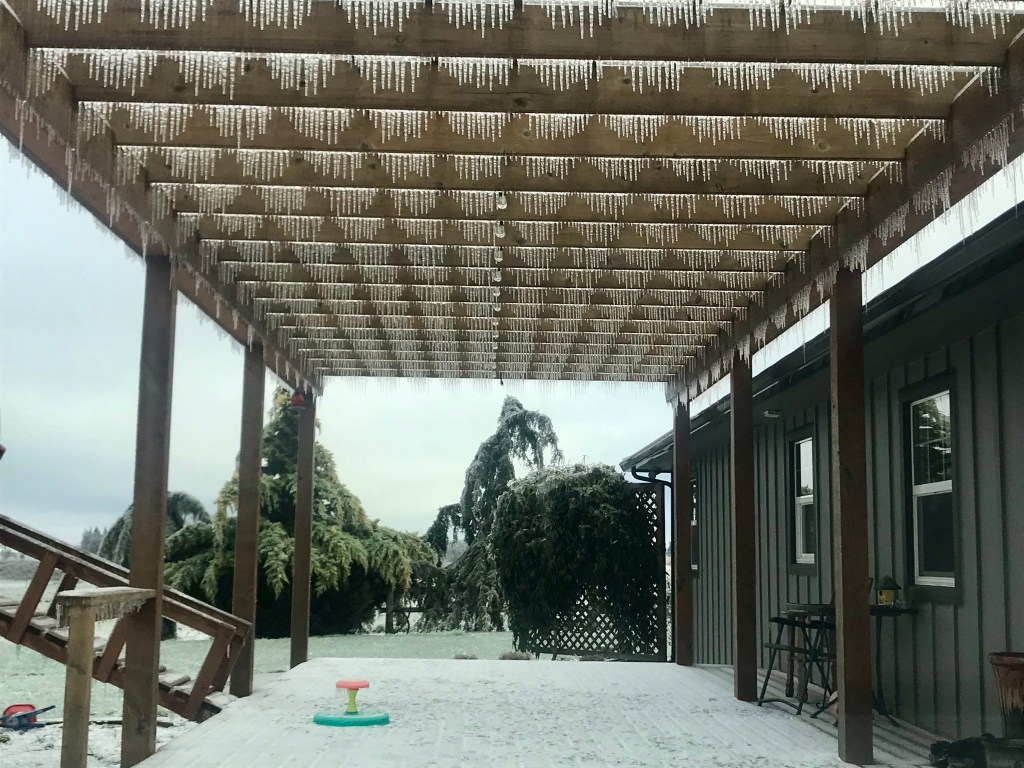
I’ve been getting a lot of questions. Are you warm? Do you have power? When will it come back on? Do you have water? How are the crops? And most importantly, “Do you have enough wine?” Since this is the top priority, the answer is yes, I absolutely have enough wine. (Phew)

Are you warm? Do you have power? When will it come back on?

Yes we are warm, no we don’t have power, and I have no idea! To be honest the first day was a little exhausting. We (aka my husband) were running around getting generators hooked up, checking on employees, getting gas, and preparing as much as possible. By day two he had the heater wired into the generator and currently we have heat, a few lights, and the TV (if you’re judging right now then you just won yourself a week with my kids and no TV to see how long you last haha!) The fridges and freezers are hooked up once the house gets warm and the cycle continues. So far so good.
As far when it will come back on….it’s not looking too promising to be a quick fix. Lines are down literally everywhere around here. Roads are closed, trees and branches are all over the ground. So far this is what we know from the power company….
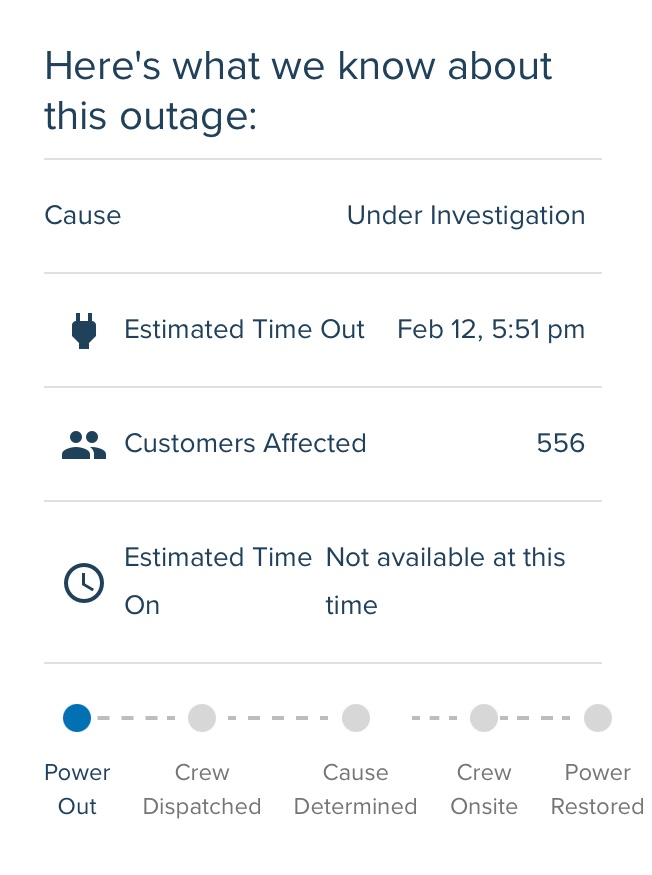
However I know that there are folks working around the clock to get people back up and running as soon as possible. We are being patient and thankful for what we have here.

Do you have water?

Not in the traditional sense. Our well can’t run with the generator that we have. So we had put some in the tub and in jugs before the power went out.

Then Hoot spent the first day collecting ice to replenish the tub water so we can flush the toilet. Yesterday we headed out to my brother and sister in laws to get some good drinking and cooking water. Thankful for family!!!

How are the crops?

Ugh this is a tough one. Probably the question that I’ve been avoiding the most. Most of our crops should be fine. The hazelnuts however I honestly don’t know.

The ice on the branches made them turn almost into mushroom looking shrubs, which is not ideal. I don’t know how many branches we have down but I assume it’s going to be a lot. Some trees have broken and split down the middle, those will be a full loss. Others will probably take years to recover.

At this point it’s hard to know the full extent of what has occurred in our orchards. But I’ll keep you updated as we move through this event and this year.

Mother Nature can be relentless. As farmers we have known that forever. I often talk about how the weather is a challenge that is unmatched and at times like this I’m reminded just how hard this profession can be. It’s also when I’m reminded of why we do what we do and continue to take on each challenge that is sent our way. It’s a testament to how much we love the life we have built as farmers. We will clean up, assess the damage, get a plan and move ahead. We will do this just as we have always done and will continue to do.

Thanks to everyone for checking in and all those who have helped so much already! And again to all the power company folks who I know are working 24/7 for everyone right now. Hope everyone is staying warm and safe out there!!

If you’re in the middle of all of this too, how are you doing??

The Start to Harvest & Dinner in the Field

Harvest like most of 2020 hasn’t proven to be “the best” quite yet. The weather has been questionable for the start to summer; which has made it a slow start for harvesting our seed crops.

I looked up at my dinner menu today and had to laugh. It looks like this….

And to be seeing that just a few days into harvest makes me want to scream and (mostly) laugh all at once. It will all get done, I know that. But the stress level of farming can drastically change from day to day and even hour to hour this time of year. Which means I am either cooking for 10 to go or cooking for 5 for at home. Which as I’m writing this doesn’t seem like a lot, but the beer you have to pack for “to go”…it’s a lot (haha!).

So for now I will just keep waiting for that sun to shine, just like pretty much every farmer here in the Willamette Valley and if you’re hungry, and can follow that menu, send me your orders 😉

Why do we grow grass seed in Oregon??

Here’s a good question, “Why are you growing grass seed on those acres and acres of fields when you could be growing food?”  Well with the recent closing of yet another food processor in this state, the answer to this question can get very complex.  So what I thought I would give you here is the answer to another question, “Why is grass seed an important crop to grow?” 

WHY DO WE GROW TURF TYPE GRASS SEED??
I should start by saying that this is the seed that you would plant for your lawn or is used on sports fields.  Our farm is about 60% turf type grass seed fields.  A mix of variety, but overall it’s either perennial ryegrass or tall fescue (both cool season grasses).  Theses fields stay in the ground anywhere from as little as two years and upwards of 15 years.  On average our fields are in the ground about 5 years.  Which means we are not tilling the soil those years, we plant in year one and we harvest every year the same plants that were originally planted until we have to take the field out.  We have a good climate here in Oregon to grow these grasses, we have an industry that has a long history of investment and research dedicated to making us as farmers able to more with less.  Efficiency on a farm has always been a big concern and when it comes to turf type grass seed that story is no different.

That’s a little background (questions can be left below), but the WHY is what we are trying to get to here.  And that is where the environment comes into the conversation, new technology, and even the simple idea of just getting outside, all play a role. 

Environmental:
If you think of any major environmental disaster, hazard spills, floods, landslides, earthquake, really any situation where there is bare soil, what is the first thing that is usually done to protect that soil from further damage?  They have to plant something, and grass is an excellent tool that can sprout to protect the soil it’s growing from on the surface and also put down roots that hold soil in place.  Roots that also can clean up the ground as a natural filtration system.  Grass in these situations is a tool used that will continue to work for them usually with little oversight and management so they can deal with the larger issues at hand.  It’s also a tool used in combating air and water pollution.  As an example of air specifically, (see carbon sequestration below), China has made an effort to increase plantings of grass to help with their air pollution problem.  The photo below is from India just this year, there are many places similar to this that can use the help from the smog.

Carbon Sequestration:
These plants that stay in year after year aren’t just sitting there doing nothing.  Like all plants they are busy year round taking in carbon.  Yes they have periods where they don’t sequester as much, but overall, grass seed crops are a carbon sequestering tool.  Think of all the good that these acres and acres of crop ground are doing for our atmosphere!  And that’s just above ground, the roots and plant material that is its own ecosystem below the ground is always working.  Our soil is our best resource and grass seed has shown to be a crop that continues the trend of soil health and fertility. 

Interesting fact: Just one acre (about the size of one football field) of tall fescue has been found to sequester 5.45 ton of carbon per year!!

New Technologies:
Our industry is always researching ways to continue to be relevant and solve problems.  One problem how to have grass in areas where water doesn’t fall from the sky with enough volume, or water sources are too expensive or being depleted.  I’m taking about drought resistance.  These varieties use less water, stay greener longer, need less inputs to look good and be healthy.  We are seeing this out in our fields as varieties are greener to the eye when we harvest, but often the seed is mature and ready to harvest.  Another example would be salt tolerant varieties of grass seed.  This serves the market not only of salty soil that’s naturally occurring, but also for roadsides where salt is used to protect motorists in the winter.  That salt can create an issue on roadsides where you need stability, this fits that niche.  Have a soil issue, have a weather issue, let’s see if grass seed can be developed to solve those problems!

Getting Outside, Being Active:
This might seem like such an obvious piece of the puzzle, but I truly believe that grass helps kids (and adults) get outside.  This grass is on sports fields, it’s out your back door, it’s in parks where you can run with your pets.  It’s in all those places that naturally reduce stress and encourage movement.  I think that as a society, this is a big part of continuing down a path of mental and physical health.  Not to mention how much cooler the ground is where there is grass growing, especially in the summer. 

Interesting Fact: It’s been shown that the temperature of ground covered with grass can be 30 degrees cooler than concrete!!

Can you imagine if all around us was just concrete and rocks?  I don’t see that as a place I’d hang out if it was 100 degrees, even if it was in the shade! And what about artificial turf?  Seems like an easy replacement right?  But did you know…..

Interesting Fact: Artificial sports turf field has a budget of $2 million over the life of 20 years, while a nicely cared for natural grass field still budgets in at under $1 million!

You know what all that maintenance and money goes to?  Rubber, labor, and zero carbon sequestration.

Side note: My own personal favorite natural grass turf field….Go Packers!

So while you’re driving around Oregon thinking how irresponsible this is to have all this grass seed growing all around us, think about the end product and markets.  Think about how important that above ground protection and coverage is, think about the carbon sequestration, think about how fun it is to go play catch in your back yard!  And that is where you will find many of the answers as to why we grow turf type grass seed here in Oregon.  Clearly this is just a snapshot of some interesting examples, but as always if you have questions or comments please feel free to type them below!