I don’t always get to do the spraying anymore. Since Matt has started farming, usually the job lands in his lap instead of mine. Most of the time it’s because you have to have the right conditions when spraying your fields. And well, the weather doesn’t always go along with my schedule of farming and being a mom. (I know the nerve of Mother Nature right?!)
But the other day he was off spreading some slug bait to try to save a field, and I got to jump on the sprayer. The job for that day, spraying round-up. We grow wheat on our farm, usually spring wheat. Because of our rotation out of grass seed crops, we usually are able to follow a perennial field with spring wheat. And we usually do this by using a no till system. Which basically means that we don’t work the ground or use any tillage. We plant the wheat straight into the old crop of grass.
This type of planting gives us many benefits. For one it allows us to once again leave our soil to not be tilled for another season. After a field of perennial this would mean that the field has gone through three seasons of not being tilled. Which is good for worms, beetles and all sorts of other living things that inhabit our soil. It also helps us save on fuel and labor. It’s a win win for our farm.
But to do this you have to do it right. Otherwise you will end up with a horrible wheat crop due to too much crop competition, and all your good work will go out the window in lost income due to a poor crop. One of the major things you have to take care of is the old crop that is still growing on the ground. This is where the round-up comes in. Round-up can be sprayed on a field, and within a week or so you will it start to die down. The previous crop will start to break down, and eventually it will get to a point when you can get into the field and plant the wheat straight into that field and dead grass.
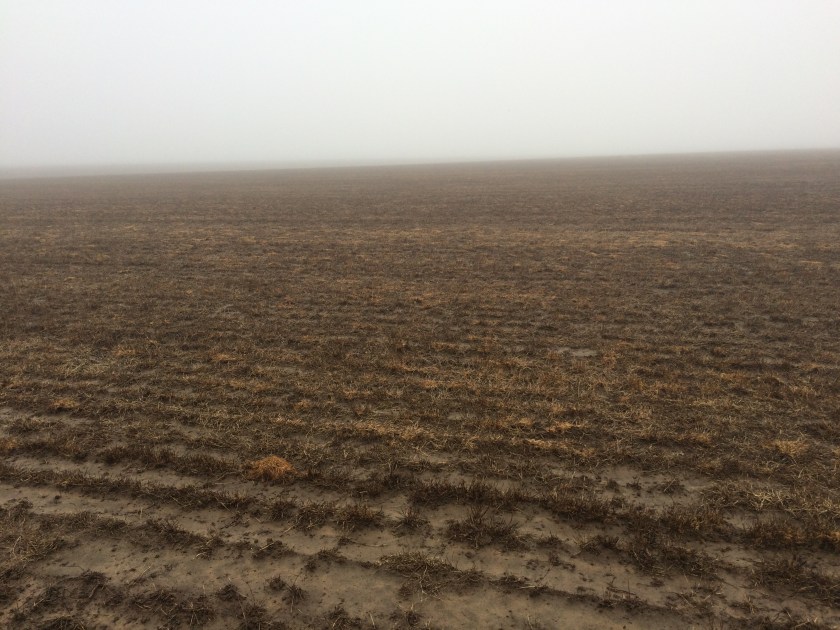 It was pretty foggy this morning, so the photo isn’t very interesting. Except to show how well the crop breaks down after being sprayed. This will make for a great field to no-till plant wheat very soon!
Round-up is a great tool for us because it doesn’t have any residual. Many of the other applications that we could make would either be cost prohibitive, or it could leave a residual that wouldn’t allow us to plant the wheat straight into the soil without tillage. Also it might be interesting to know that on one acre I was only spraying about a pop can full of glyphosate, the active ingredient in round-up, along with 15 gallons of water. So to give you a visual, imagine a football field. Now take 15 gallons of water and a pop can full of chemical and spread to evenly all over all 100 yards. Pretty precise if you ask me!
I hear so many negative things about the tool of round-up, so I thought I would add a story about a practical use of the product. One that helps us do more with less, helps us keep our soil healthy, and helps us continue to rotate our land from crops to crops and year to year.
Like what you read? Share it here...
 We have also had some sunshine here, crops will be starting to enjoy the warmer temperatures in the soil and spring to life soon. So out to the swings it is for our little farm boy!
 Happy Friday folks!


 NuttyGrass