GM Foods & Hamsters…Don’t be Afraid!!

I recently read an article that was written about GMO foods and seeds. It was brought to my attention by the U.S. Farmer’s and Rancher’s Alliance, Food Dialogue website, they send out articles and publications that may have a negative outlook on agriculture and ask for people to respond, blog, tweet, facebook, etc, on what they think of the issue. The most recent article was entitled “GMO-fed Hamsters Become Infertile, Have Stunted Growth.” With the small tag line underneath reading, “Overall GM sounds like a sweet deal only for Monsanto (and our own FDA and USDA, repeatedly found in bed with them). It remains a bad deal for us, the consumers.” I encourage you to read the article and see what you think, but I also encourage you to read this blog afterwards, maybe I can help put some of your fears at ease. I plan to not use fear to convince you of what I believe about GM products and seeds, ps…I’m not in bed with Monsanto either!

First I was take a back by the article because it never actually cites where it got any of the information that they are claiming as facts, makes me nervous! Plus why all this bashing, when the reality is that Genetically Modified seeds have a very positive side that isn’t once talked about in this article. These are a tool that has come from technology that allows farmers to feed more people with less land. Just as GPS technology helps us be more efficient, we take all the gains that we can to produce the healthiest food per acre that we can. And we’ve come a long ways, today the average farmer feeds 155 people, in 1960 that number was only 25.8! So how can that be possible, mainly because of advances in technology, including the use of GM seeds. Here is another great article that outlines some of the advantages to feeding more with less. But this isn’t to say that we find out a new technology is there and right away everyone is using it without regard to any harmful side effects. Actually it’s the exact opposite! GM seeds and foods have been tested over and over again, and are still being tested today to make sure that they are safe for human and animal consumption. And it’s not only the FDA and USDA doing this research, the EPA and WHO are also involved in testing foods all the time to make sure that what we produce is safe. Here are a few of those regulations:
http://www.fda.gov/Food/GuidanceComplianceRegulatoryInformation/GuidanceDocuments/Biotechnology/ucm096149.htm
http://www.fb.org/index.php?action=newsroom.focus&year=2011&file=fo0822.html
http://www.fda.gov/Food/Biotechnology/default.htm

http://www.fda.gov/Food/Biotechnology/Submissions/default.htm

I think the average consumer would be amazed at how much research is truly done before products are given out or sold to the public. The same goes for pesticides, insecticides, herbicides, they are all under a microscope all the time to make sure safety is at its highest level. Maybe the biggest testament to this is the fact that as a farmer, I eat GMO products, my family does the same. I’m glad that we have a choice to eat whatever we like, and farm the way that we want to farm. I also appreciate all the hard work that companies put in to make sure that what we feed our kids is safe. All at the same time I don’t appreciate fear marketing to try to get people to have a bad taste in their mouth when they see GMO on a label, because if they ate what’s in the package, that taste in their mouth would still just be delicious farm grown corn.

Just be mindful that fear is out there and it’s a powerful voice, and I know at least for me, it’s made me always second guess when I see an article bad mouthing a practice that is helping to feed our ever growing population, without even mentioning any of the benefits it can bring.  Also a thanks to the USFRA, it’s nice to know someone is looking out for the best interest of American Agriculture!

Farm Organization…at its Best

All through business school I learned about “Job Descriptions” and how important they were. I also learned that in order to fill out any type of application you had to be able to put down your job description. It was very important and something that we learned about, wrote about, studied on…then I started work for the farm. There are many things that change once the reality of the real working world hits. You realize that your job description that you applied for, can be changed, re-defined, or just one of those jobs where no one actually knows what you do while you’re busy at work all day. But then you come to work for your family’s farm, looking for direction and realizing that there aren’t job descriptions on a farm, there is just work!

So with the many constant projects on a farm, who does what, who is in charge of that and who checks to make sure it was done right?? I gotta tell you, it’s still quite a cluster this time of year, looking like chickens with our heads cut off running around to this job and that. Between changing equipment over for different crops, shipping crops out the door, and receiving crops at the same time! Trying to keep crews busy in the down hours of the day, while also making sure that you’re check on them or wake them up from their naps! And of course along comes all the unexpected, the broken shafts or sheer bolts, that weird sound that has started on the combine header or the squeaky driveline that has decided today is the day it will give out. The list goes on and on of what can be worked on. And when that moment comes that you think there just might not be one project left to work on, unfortunately that is the day that you get to clean the dreaded shop bathroom! It’s amazing the kinds of things you will find to keep yourself busy when you know that is the last project on the list!

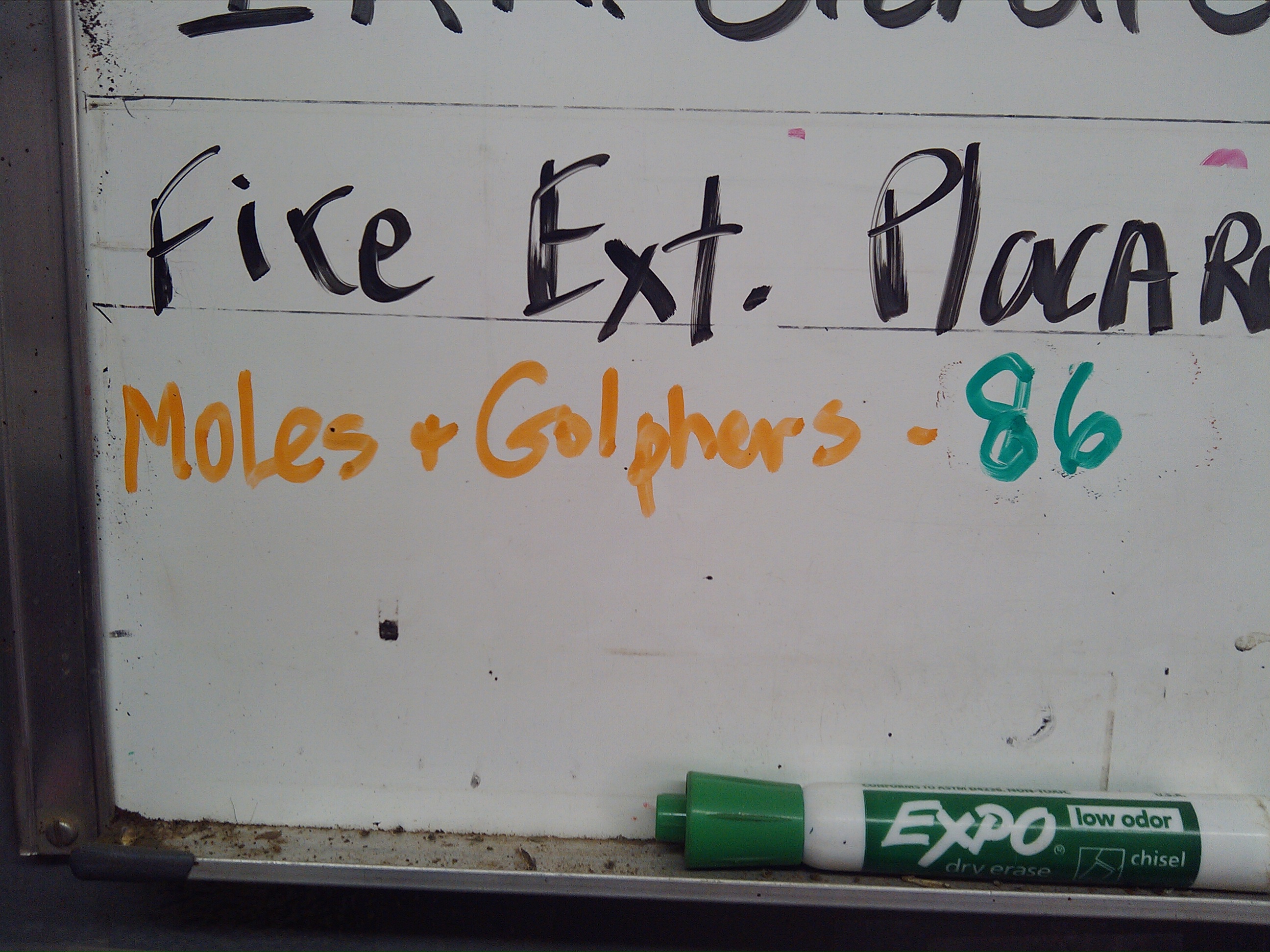
This may look like chaos…but it’s really quite organized!

I don’t have a clue how other small businesses work, and I’m sure it’s a bit more streamlined than us. But here is one way that we here at Kirsch Family Farms keep ourselves somewhat organized. It may seem a bit archaic with computers and smart phones on all of our hips, but this is our own version of Google Cloud you could say. “The Board” it’s referred to. If something is not written on “The Board” I’ll be honest and say odds are about 1 in 100 that it will get accomplished in any kind of speedy fashion. But at the same time we have a few items up there that have been on “The Board” so long I don’t think any amount of cleaner will get them off. We keep track of equipment to fix, parts to pick up, parts to order, moles dad has killed (this is my favorite), meetings to attend, field work to be done, spraying to finish up, the list goes on and on!

Way to go Dad!

So with my description-less job of farming, I just keep chugging away and wiping things clean off “The Board”, all the while adding every day the next project to hopefully keep me out of the toilet cleaning job!

Why I want to End the Oregon Death Tax…

I have been working on a campaign to End the Oregon Death Tax for about 6 months now.  It all started when I got wind of a small gathering in my town to talk about the death tax and an initiative that was hopefully going to make it to the ballot this coming November (with a lot of work, signature gathering, money, etc.)  I feel like I’m a fairly informed person, I love to learn and read and try very hard to keep up on what is going on, especially when it comes to issues that are close to the agricultural industry.  So when I heard a lot of facts about the death tax in Oregon, I realized that this issue was much more detrimental and harmful than I ever expected.

I know that I have written a blog about this issue already (as have many of my friends) but I feel as though lately I’m getting more and more questions about why this is important and more and more statements from people about why farmers have never been and aren’t going to be effected by this and it’s all about big rich terrible slimy investors saving in taxes.  I’m sick of people asking me how much my farm is worth, and then telling me that there is no way I will reach an exemption.  I’m sick of people looking at the death tax as a non-issue just because it doesn’t affect them since they aren’t millionaires.  So here you go, all you naysayers!  Here is my honest story about why the Death Tax WILL affect me someday.
  1. To those who say farmers have never been and won’t ever be affected…
    I personally know of farms that have been split up because of the death tax liability.  They have had to sell off portions of their farm, split up a family business, and take huge hits personally because of a death of a parent.  To those who want specific examples, that is as specific as I will get because it’s their story to tell. 
  2. To those who want to know how much my farm is worth and if I will reach the exemption…
    I want to give you an example of a typical farm in my area. 1000 acres of prime farm ground, market value can be upwards of $10k-15k per acre.  Right off the bat with only the land, not including buildings, houses, shop equipment, harvesting equipment, large tractors, trucks, etc, you are hitting $12 million dollars.  So let’s say that both parents die, and the agricultural exemption (even though no one can really explain it to me clearly) is at $7.5million per person.  If we take a conservative land value amount along with all the other things involved in running a farm you’re still left with about $3 million that is taxable, usually at a rate around 10%.  Are you still doing the math?  It’s $300,000…in cash…that you and your siblings as heirs have to pay to the state within 9 months.  Do you have that kind of cash??  Or do you expect a farm to have that kind of cash when over farms are usually very leveraged against that land just to make their operating loans every year?  And just as a reminder, majority of these farms are generational, so as it is in my case, more than likely the family a generation before has already paid the tax on that same base of land.
  3. Death Tax is a non-issue and won’t affect anyone other than millionaires…
    This tax, doesn’t just tax the rich, it inhibits and discourages successful business to come into our state.  Oregon is becoming an increasingly business unfriendly state and I think this is another way that we can start to turn that around.  You can’t have a healthy economy without jobs, and you can’t have jobs without businesses willing to come in, invest in our state, and plan to stay for the long haul.  I can’t move my business, but I have to tell you that after paying income taxes, after dealing with measure 66 and 67, there is a large part of me that wishes I could pick up my soil and move it to a state that sees the common sense piece that in Oregon we are missing.  I am not a millionaire, my dad is not a millionaire, and my grandfather was not a millionaire.  We are farmers who just want to be able to farm the soil that generations of blood sweat and tears have given to us.
As you can see I’m passionate about this issue because I honestly see it as a true road block for my future here in Oregon agriculture.  Please take the time to look at the issue, contact me if you have questions and I will try to help to clarify, and please help us to get this out of our state so we can start healing and making Oregon’s economy better for family business.  Also just fyi…signed petitions are due July 6th!