The first filbert (aka hazelnut) trees planted on our farm were in 1990 by my parents. They were the Barcelona variety that is common in our area. We have slowly been taking out blocks of these trees and replacing them with newer varieties. Mainly this is due to Eastern Filbert Blight that has become a losing battle and we felt like our trees, no matter how much money we poured into them in the form of labor and preventative sprays, were still going backwards.
While not wanting to take acres out of production all at once; a filbert tree takes about 4 years to start producing a crop and then another 6 until they would be considered more close to maturity, we didn’t want to take that hit all in one solid block.
So a number of years ago we started with 25% of the trees and have been slowing chipping away. This winter we decided that it was time for our final block to be removed. Now once the ground gets a little drier we will prepare to get new trees planted this spring.
This isn’t an easy decision to make. A neighbor farmer once told me “We don’t want to take the trees out when the price is low because we need as many nuts as we can get for our yields to make up for the low price. And then when the price is high, we need as many nuts as we can get to make back the money from the poor years.” So when then does someone make the call to remove the tress?
It wasn’t an easy decision. However with the new varieties coming online they are producing faster and getting us back to getting some return on the land faster than before. This past year the first block of trees that we planted 4 years ago to replace our removed Barcelona trees actually produced about half compared to the 34 year old trees. Which has a lot to do with better yielding varieties, different spacing with more trees per acre (we didn’t double density plant but changed our spacing to a tighter pattern), and less inputs in the form of less sprays and less pruning labor.
Last tree standing.
So as the other acres come online with newer varieties so will this one in the near future. I’m hopeful that we can keep these trees in for a long time. You never know what lies ahead, new blight or pests or climate that can change our growing seasons around here, but I hope that we can treat these trees like the permanent crop they are meant to be.
I have spent countless nights since I decided to farm thinking about this one phrase, “It takes 2 generations to build a farm and one generation to lose it.” I’m not sure if the weight of those words resonate with you, but from the moment I heard them I felt my shoulders carry a burden.
In some ways it has created motivation for me and continued drive to keep moving forward, keep innovating, keep learning and striving to continue on. In another way it has created this fragile framework of a legacy that rests here with me deep in my soul. Some days I can bear that, some days it scares the heck out of me.
My sister and me with generation 1, my grandparents Carl and Clara.
My dad and I at the start of our farm transition as the 2nd to 3rd generation.
I’m the third generation here; on this land, with this soil, and while the equipment changes, the workers (while rarely) come and go; I feel the weight of “will it be me?” Will I be the one to have to shut the doors after generations have laid the ground work for success?
When Matt and I were first starting out we hit some difficult obstacles. My parents while no longer the owners of the farm reminded us many times, “We want you to succeed. We are here to support you and be behind you no matter what changes you make to make it work for your family. You guys can do this.” That unwavering support got us here today to year 2025 starting our 7th year as owners. And it is where I always want to start when Matt and I talk about what it will look like when our kids possibly chose this life. What is the first step? It’s helping them be successful in an ever more difficult world that is farming and it’s giving them the freedom to create their own version of this legacy knowing that we are there supporting them.
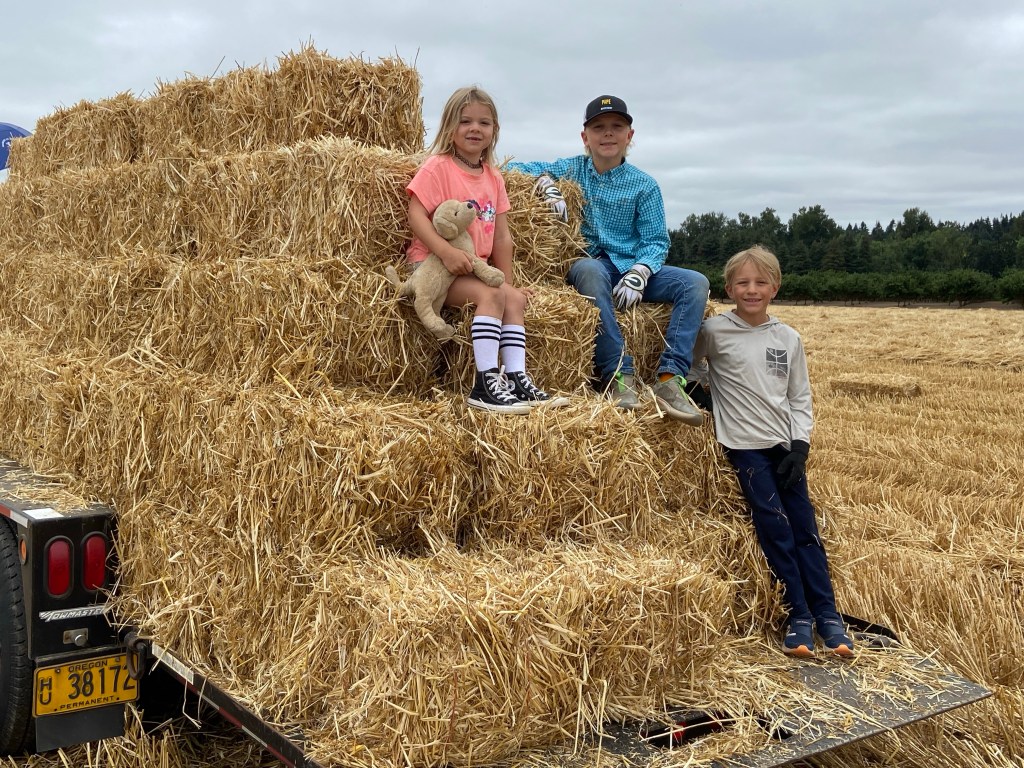
4th generation of farmers (Hoot, Auggie & Millie) at Kirsch Family Farms.
This creates a two fold scenario in my life as a third generation farmer. On the one hand it fuels me to stand up for our farm and our land, fuels my passion for being an advocate. And it also creates room for me to accept that there may come a day when we have to pivot so drastically that our legacy and our farm will look very different than it has for generations.
A good friend and a farmer that I respect very much Anne Krahmer-Steinkamp posted this on New Year’s Eve…
Goodbye 2024!!!
Anne with her husband Andy and daughter Sage on New Years Eve.
So happy to be saying goodbye to 2024!!! It been a year of heartbreaks, tears and anger. It’s also been a year to show me what the true important things are in life!
For those that don’t know we sold Berries Northwest. The last 5 years, we have been a punching bag to weather, bad marketing, inflation, politics and broken promises. Sad to say we have not been the only ones in this boat. I know a lot of farms hurting.
In all this I have learned an important thing! I thought we were losing our family legacy and felt like a failure. But I was wrong! The legacy is the heart and love to being doing what we do of getting to feed America!! It’s not the bush’s and land, that’s just stuff. And stuff will come and go. The true legacy I believe is the one my family has been doing for 6 generations, working hard to feed the world with the heart and passion of love!!
In all this we keep 23 acres of blueberries. I am excited for this next adventure and will keep fighting to do what we love even if just part time. We are off tonight to go enjoy our friends in celebrating the end of this year and ring in the new one!!!
We wish everyone a happy new year!!🎉
She’s not wrong. Her legacy is fragile but her legacy like many of ours in agriculture can be maliable. It can change and transform and that’s ok. We don’t have to hold the burden of doing the same things because our grandparents did. Even though the rest of the world outside of ag will assume that’s all you’re doing.
And all of this lifted a little bit of that burden that I feel is on my shoulders. It took courage for Anne to say what she said, I can appreciate the emotion of just typing out those words to share. Especially the “…that’s just stuff and stuff will come and go.” This spoke to me because she’s not talking about little things, she’s talking about generational tangible “stuff” that hits more deeply for many of us in generational family businesses.
I hope I can always have her courage; to work hard, to see when change is needed, and to be proud no matter what piece of our legacy moves forward. And do that alongside supporting the 4th generation of this farm and this story, however that may look and with whatever “stuff” comes along with it.
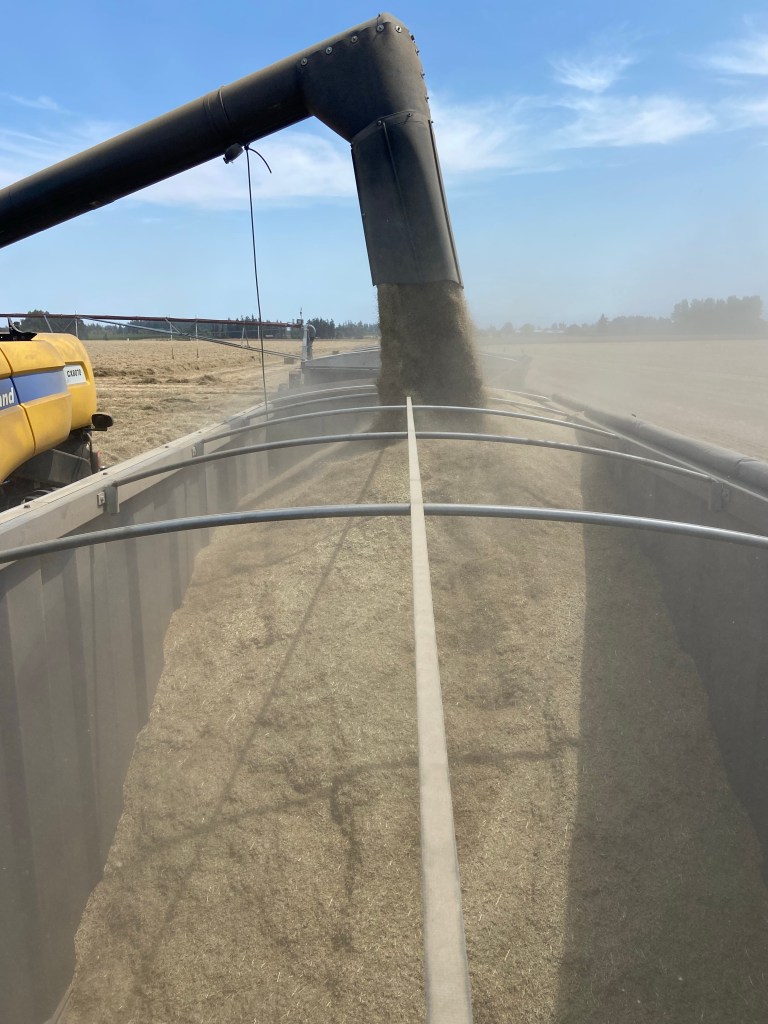
Somedays it feels like we just got started harvesting grass seed this summer. And other days it feels like day 8,537. But irregardless we are wrapping things up on grass harvest of 2024.
It’s gone pretty good. The straw yields are way up. The seed yields are average to up some. It was a strange year with conditions feeling different almost in every field we went into harvest. Lots of setting and resetting of our machines which makes for longer days or at least longer feeling.
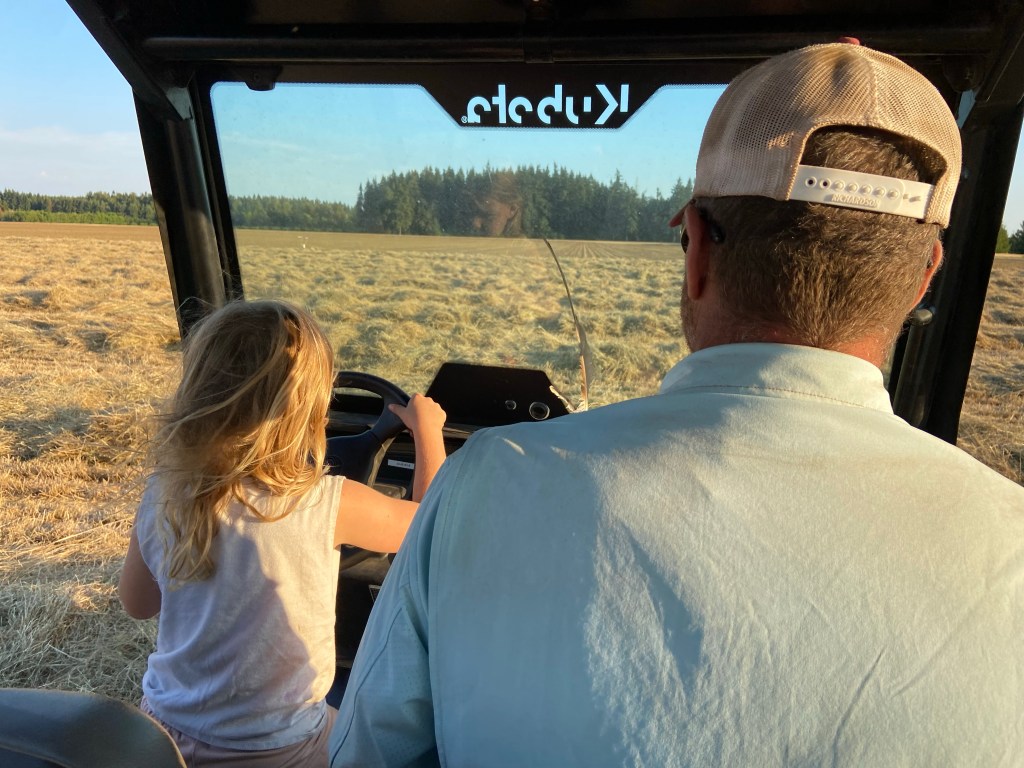
We also added two new drivers into the mix as subs when our main two drivers aren’t here. One was our son Hoot, who did an amazing job and took to the job very quickly. Millie also learned to drive the ute, so life looks a lot like getting chauffeured around lately.
Next up is wheat. Which is one of the most fun since it also means the kids get to bale up their small decorative wheat bales for porch decor for this coming fall!! Stay tuned for a chance to get your hands on those cute little things!
Finishing up this crop feels like we finished a marathon that started about a year ago. And one that will start again here shortly as we start to take care of fields for the next years crop, giving some water to start up again, working ground and planting the fields that are rotating, and overall making sure that we set up to reset for another year of farming.
But like I said we still have a little ways to go for this year’s harvest. Wheat, radish and filberts are still left for 2024.






 NuttyGrass