Minimum Wage Hearing

Last week was the first big call to action for this short legislative session for farmers. The hearing was in regards to raising Oregon’s already high minimum wage. And if anyone was in doubt if this is a big topic this year I think you would have only had to show up at the capital that evening to see hundreds of people there to give their view. 

A good friend of mine, fellow blogger and great agvocate, Shelly Davis shared her thoughts and pieces of her testimony on her blog, Daughter of a Trucker. So I wanted to share it on here today because while I didn’t physically have the chance to get to the capital that day I was glad that part of my “tribe” made the trip to share how many of us in agriculture feel about this issue. 

  To see this post follow this link:

 http://daughterofatrucker.com/2016/01/15/i-am-oregon-business-a-follow-up-to-the-minimum-wage-hearing/ 

While we all want people to earn a fair wage, the ways in which to get to that point will be debated extensively this session. I just hope that people will realize what a bandaid just raising minimum wage will be for our state. And it will only shortly hide the real issues with a non business friendly state if we aren’t careful. 

American Farm Bureau Presidental Election

When I was in kindergarten I remember telling everyone at school that my dad was the President of the United States. I also preceded to tell everyone that I would be the first woman president. Hey if my dad can handle it, I know when I grew up I could follow in those big footsteps right?! Well little did my little 6 year old self know but my dad wasn’t the president of the United States, he was the president of our county Farm Bureau and while a very prestigious post, not really quite the same thing.

That memory always brings a smile to my face.  And lately I have been thinking more and more about it as the American Farm Bureau has been working its way to a new President for the first time in 16 years.

Obviously from the story above you can see that since I was a tiny kiddo I was aware of and grew more active in Oregon Farm Bureau. It was a number of years ago that I first met Barry Bushue, Oregon’s Farm Bureau President and quickly saw a great leader and someone who always worked hard to understand the issues and look for a balance in how to deal with them. Today Barry is running for American Farm Bureau (AFBF) President. Beyond his obvious qualifications including being Vice President of AFBF since 2008, and serving on national committees for both AFBF and the USDA he has also been a tireless advocate for all Oregon agriculture. Which is not an easy job to take on.
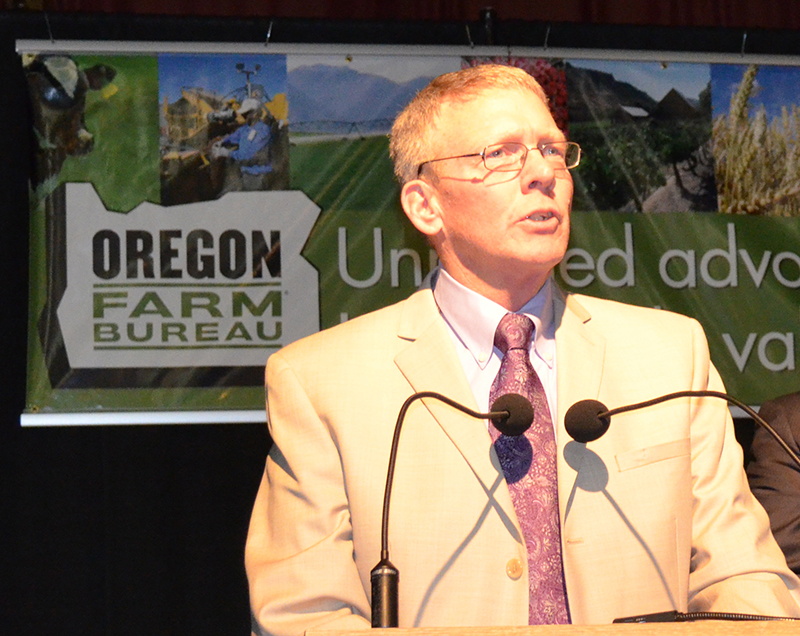
barry_bushueOregon is blessed to be a state where agriculture is very important, with its diverse growing region with over 250 different crops, it also serves the economy by proving 1 in 8 jobs.  Which is all great, but it tends to foster an environment where sometimes it’s hard for all farmers to always get along.  It’s one of the main challenges that we have here in Oregon, keeping farmers from going against other farmers.  Whether it is organic vs. conventional, or wine grapes vs. grass seed; Barry has had to take on these challenges time and time again. His continued testimony of coexistence, while using common sense and science to bring farmers together on issues is well respected and well known.   I have had the pleasure of testifying next to him in legislative committee hearings, and I always come away from those experiences proud to have Barry represent me as a farmer here in Oregon.
indexOn the national front I think that the challenge for farmers, while diverse, is becoming more aligned as large groups aim to hurt the American farmers and the tools that we use to grow healthy and safe food, fiber and fuel for the world. Barry is no stranger to this conflict, he comes from the heart of some of the most controversial legislation and fighting that we have ever seen in agriculture.

I have no doubt that any of the four men running for AFBF President will do a good job of moving farm bureau in a well rounded way into the future. But I think that Barry has already cultivated the skills required and the thick skin necessary to lead our national policies on agriculture for all farmers!

Good luck Barry, we will all be rooting for you!! And my 6 year old self will really look up to you, I mean if a country president is equal to US President, American Farm Bureau President is basically like ruling the world!

To learn more about this great leader please visit his website: www.barrybushue.org

Wine & Grass Seed Tour 2015

Last week I posted this photo from Shelly Boshart Davis…

IMG_4624-0I mentioned that it might seem strange in an agricultural area such as the pacific Northwest, an area known for growing over 280 different crops, that there may be some contention when it comes to farming as neighbors.  But in the past year or couple of years it has become apparent that there are risks when farming next to wine grapes and grass seed.  The problem comes during the spring.  Grass seed farmers, who need to keep their fields free from weeds in order to produce a high quality product, have to spray broad leaf herbicides around the end of March to beginning of April, depending on the weather each year.  These herbicides have traditionally been in a formulation that when put in the wrong conditions can “move” or “volatilize” and grow legs so to speak.  The herbicide then can move off the target site of a grass seed field, and drop onto another crop.  The biggest scare is when it decides to move to a vineyard that is nearby and if that vineyard is at the growing stage of bud break.  This is when the buds or fruit for the coming year start to come out of the vines.  This can cause a lot of damage to that vine for that year and in some extreme cases damage can last into the following season.

Obviously there is a reason to be concerned here.  Wine in Oregon has grown as an industry in our area in the past decade or so.  Oregon has been put on the map for their Pinot Noirs and I don’t see an end to the expansion into this market.  Grass seed growers have been around for generations here in Oregon building livelihoods on the mild climate and touting the name Grass Seed Capital of the World.  Actually 2/3 of the world’s grass seed comes from Oregon!! In the end, both industries have value here in Oregon agriculture.

So when winegrowers last year went to the legislature to try to take away those herbicide tools from grass seed growers, it woke a lot of us up to the fact that this is an issue that needs to be dealt with farmer to farmer, not through legislation. The tour that was sponsored by Oregon Seed Council and Oregon Winegrowers Association was the first step in doing just that.  There was a lot of talk about getting to know your neighbors.  Stories about vineyard owners bringing over a bottle of wine to talk about timing and crop rotation were told.  Success stories of farmers working side by side successfully for years were shared.  The ground work of moving forward with more education was set.

It’s easy to get defensive when practices within an industry collide.  I know that when we get farmer versus farmer in any forum it’s hard to swallow because both have their reasons for why their side is right or should get priority.  Who was there longer, who has a higher value, who is from this state and who isn’t.  These issues come to the surface so fast and with so much emotion it’s hard to sort through.  But when you look at the bottom line, that neither of us wants the other gone, we just want more communication and education about what is happening just over the fence row; that’s where you can start to work together to find solutions.

Here are a few things that I know:

  • On our farm we usually spray our herbicides (that could be harmful to grapes) at the end of March.  In most cases this is before bud break (usually at the beginning of April) for vineyards and a very safe time of year to put on our herbicides.
  • We are aware of drift issues and continually take classes and go to seminars that talk about how to reduce drift.
  • We are licensed applicators who want our pesticides to work in the most effective manner, to accomplish that we are always checking conditions such as the weather to make sure that our chemicals stays where we put it to get the job done.
  • Calling our neighbors for any sort of issue or question is not just a sometimes thing.  If there is anything we need to talk about or inform them of, they are just a phone call away.
  • Education even to homeowners in an area about the use of crossbow and other sensitive herbicides, which can be very harmful to grapes as well, is really important.  For example making sure they understand that October is the best time to spray blackberry briars to actually kill them, not in the spring or summer.

I walked away from the tour encouraged by what I heard from both sides of the conversation.  I hope that this tour continues and grows to include a more and more diverse set of attendees.  We are all here in Oregon because of the good soil to grow everything from Christmas trees to vegetables, grapes to grass seed and everything in between.  To keep tools in the toolbox to satisfy all our diverse practices here, there has to be an effort to work together in an ever changing landscape of crop rotations, markets and weather.